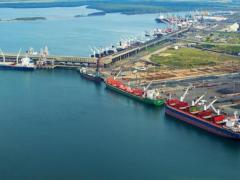
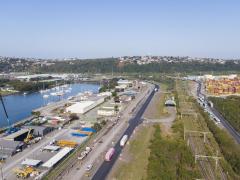
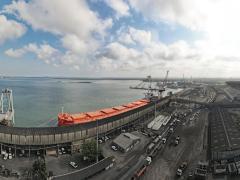
The Automotive Industry Development Centre (AIDC) recently measured the comparative efficiencies of Walvis Bay, Port Elizabeth and Durban for a 40 foot container from Gauteng to Europe. FTW takes an in-depth look at the results. THE PROBLEM of throughput capacity constraints in the SA port system is a substantial concern to the SA automotive industry, according to Hannelie Viljoen, project manager in the supply chain development department of the Automotive Industry Development Centre (AIDC). “For the industry to improve its supply chain competitiveness,” she told FTW, “it is pertinent to strategically evaluate alternative import and export routes to alleviate the current situation.” A first step in this process has been a full-scale study of the alternative of Walvis Bay – jointly conducted by the AIDC and the Walvis Bay Corridor Group (WBCG). “Walvis Bay is located about 1 800-kilometres from Gauteng’s component manufacturers,” said Viljoen, “and the study focused on outbound ocean freight supply. “We investigated the suitability of this corridor by tracking actual shipments.” In the evaluation, four 40-foot (12-metre) containers from the manufacturing companies Bosal Afrika and Hayes Lemmerz, which assisted in the study, were shipped to the port of Antwerp in Belgium – then forwarded into Europe. Two of the containers were road hauled along the trans-Kalahari Corridor (TKC) to Walvis Bay (WB). Due to insufficient volumes this cargo was not shipped directly to Antwerp from WB but transhipped via Rotterdam. Meanwhile, to offer a comparison, the third container was sent by rail via Port Elizabeth and the fourth by road via Durban. “The results of the performance measurement of the WB-TKC were benchmarked against both the Durban and Port Elizabeth corridors to obtain an understanding of the potential benefits of the WB-TKC for the automotive industry,” said Viljoen.
SA port constraints motivate study
Comments | 0
© Now Media. This content is protected by copyright and may not be adapted or republished. If you would like to discuss cooperation opportunities, please contact: editor@freightnews.co.za.