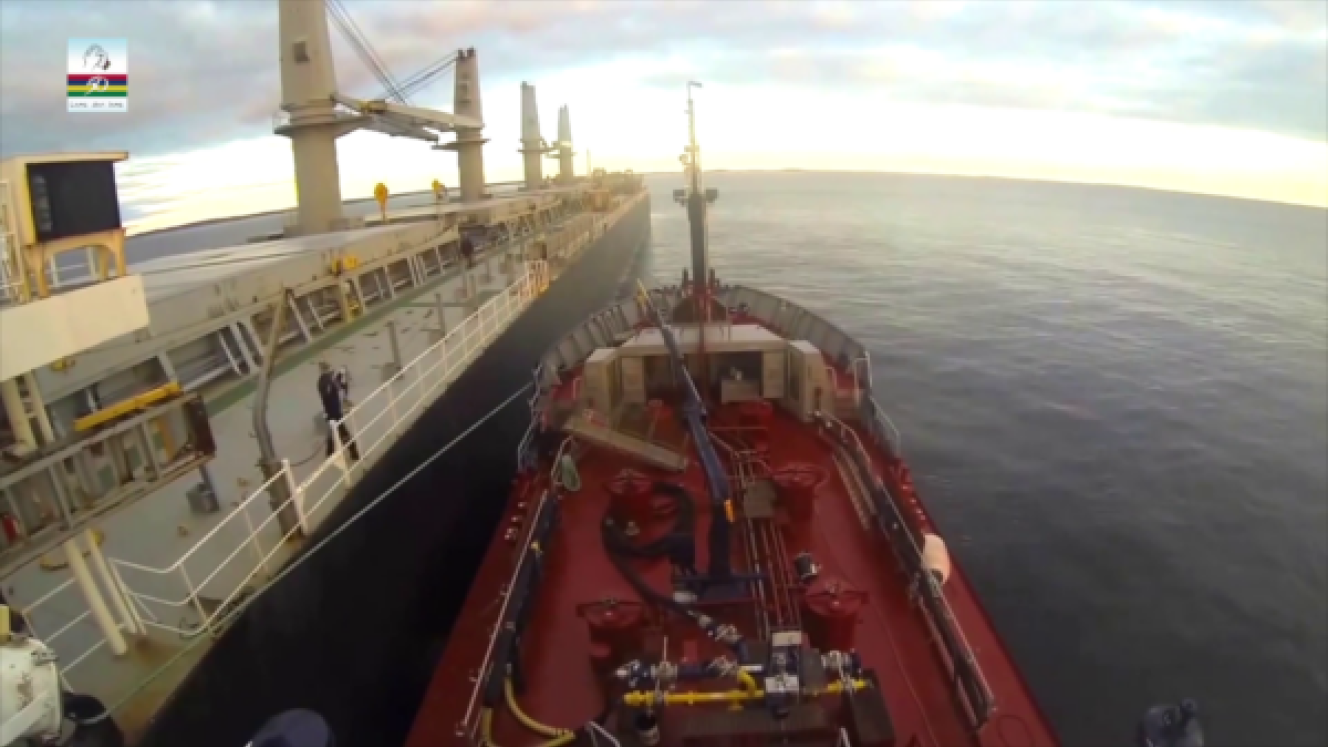
Vessels are choosing to bunker in Mauritius rather than South Africa, with the Indian Ocean island now handling more than one million tonnes of bunker fuel annually.
Speaking at the Oceans Economy conference in Cape Town last week, industry stakeholders warned that South Africa had failed to fully capitalise on opportunities created by the Red Sea crisis and vessel diversions while Mauritius benefited from years of strategic planning, regulatory certainty as well as increasing private sector participation.
“South Africa’s bunker volumes have dropped from a peak of more than 3.5 million tonnes per annum to around 840 000 tonnes a year across Cape Town, Durban and Richards Bay,” said Wilhelm Wasserman, Business Divisional Manager: Marine at FFS Refiners.
Several factors had contributed to the downward trend, including the introduction of offshore bunkering in Algoa Bay around 2016, which shifted some volumes away from the ports themselves.
The move to low-sulphur fuel in 2020 and disruptions at several local refineries added further pressure, Wasserman said. “The introduction of IMO 2020 was a significant turning point as South African refineries were unable to produce the required low-sulphur fuel in sufficient quantities.”
The prolonged shutdown of the Astron refinery, the explosion at the Engen refinery and the closure of Sapref had transformed South Africa from a net exporter of residual fuels into a net importer, he added.
The sector was hit again in 2023 when SARS detained five vessels, including bunker barges, halting offshore bunkering in Algoa Bay for more than a year.
The disruption coincided with increased demand as vessels rerouted around the Cape of Good Hope. “There was a slight uptick in 2024 due to the Red Sea crisis but South Africa has not benefited from it in the same way as other ports, nor has it fully benefited from the current Middle East tensions,” said Wasserman.
Bunkering is a business
Mauritius is an example of how a long-term strategy can transform a bunkering sector. “In 2019 Mauritius was handling around 600 000 tonnes a year. Today it exceeds one million tonnes annually and has overtaken South Africa's combined bunkering volumes,” he said.
“They have made it easier to do business and the market recognises that. The key difference between Mauritius and most African ports is that they treat bunkering as a competitive international business rather than simply a port support service,” he said.
According to Wasserman, Mauritius capitalised on opportunities created by the Red Sea crisis and vessel diversions through a combination of market liberalisation, private sector participation, efficient vessel turnaround times, investment in onshore and offshore bunkering infrastructure and a stable regulatory environment. It also used the crisis in Algoa Bay to its advantage.
A visit to the Mauritius Ports Authority website reveals a bunkering strategy dating back to 2014. “It outlines how [Mauritius] has reduced levies, removed certain taxes, lowered port costs and made it easier for customers to understand exactly what services, capabilities and offerings are available. In comparison, if you visit the TNPA website, you will find dredging services,” he said.
If South Africa wanted to increase bunkering volumes it would have to embark on a far more aggressive strategy than what has been the case to date, Wassermn said.
South Africa had made progress in opening the sector to greater private participation, but the pace of change remained slow, he said.
“Mauritius moves quickly, and that is not only in terms of infrastructure and concessions. It is about development, support, efficiency and strategic positioning.”