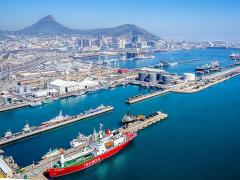
At least eleven ships remain under arrest in the port of Cape Town, a clear indication that South Africa has regained its standing as one of world’s most favoured maritime jurisdictions for claim relief. Ship arrest is, as maritime lawyers pointed out at a recent presentation in Cape Town, a sure sign of the global economic malaise which has not only led to many orders being cancelled for new ships but to breaches of charter contracts. This despite charter rates way down, from US$230 000 a day to US$23 000 a day in November for Cape-size vessels of between 120 000 and 200 000 tons. Gavin Fitzmaurice, a partner in the law firm Webber Wentzel in Cape Town, says South Africa’s Admiralty Act 105 of 1983 represents an approach to maritime law hailed by practitioners the world over as the leading example of how matters should be dealt with. Chief among the issues the Act successfully grappled with was how to permit litigants to enforce claims, or obtain security for claims, from shipping defendants who had arranged their affairs typically by way of one ship owner. This Act permits the arrest of so-called ‘associated’ ships so that if a claim arises in respect of a particular vessel, known as the ‘ship concerned’, one would in other jurisdictions be limited in most instances to either arresting the ‘ship concerned’ or a sister ship owned by the same owner. “In this jurisdiction,” says Fitzmaurice, “one can pierce the corporate veil (Section 3, brackets six and 7) of the Act to arrest a ship which although not owned by the same defendant company, can be proven to be subject to a common control. “South Africa is the pioneer, unique in this, and leads the way to provide a remedy for local and foreign litigants to enforce or get security for their claims by way of associated ship arrests.” South Africa’s limelight faded a tad in the last four or five years when the New York courts and legal practitioners developed the so-called Rule B attachment procedure. This enabled a litigant anywhere in the world to approach a New York court seeking security for a claim against a maritime defendant by seizing cash in US dollars through the US transferring banks – but such ‘cash’ relief is not applicable under South African law. Fitzmaurice says the convenient Rule B procedure is however on its way out, if not “already dead and buried”, given that a new ruling forbids cash to be seized if a defendant company has a New York registered office, a procedure now followed by most shipping companies. “Mirroring the end of that remedy, South Africa has seen a significant rise in ship arrests, back to the levels of the 1990s and it’s on the increase in all ports.” Fitzmaurice says the phenomenon has increased at least six or seven-fold in Cape Town, from one or two vessels a month.
SA leads the way in ship arrest procedure
Comments | 0
© Now Media. This content is protected by copyright and may not be adapted or republished. If you would like to discuss cooperation opportunities, please contact: editor@freightnews.co.za.