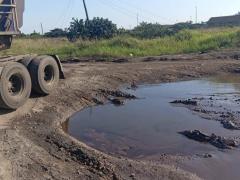
WITH HEAVY vehicle accidents involving spillage of toxic or combustible fluids or powders occupying press space recently, FTW set out to try to quantify what appears to be an ever-increasing accident rate. But it’s like a search for figures for murder or hijacking rates, or crime rates in general – a rather forlorn hunt. Or, if you want a business-related equivalent, try getting any national figures for airfreight exports and imports and you’ll have an equally frustrating search. It’s reminiscent of the sanctions days in SA, when market research became an impossible task, with facts and figures about SA industry and commerce now a state secret. It got so bad then that even the National Association of Automobile Manufacturers of SA (Naamsa) – which has always produced reams of statistics about the SA motor industry every month – went silent for a while. In these days of supposed “transparency”, you’d have thought that a subject like “toxic or combustible spills” would be of national public interest – both to the producers and to the transport and associated industries. But it’s not that easy. Gerrie Botha, the man who handles road accident statistics at the department of transport, did promise to try to extract such figures from his general accident database. But it will require a considerable amount of “mining” through his figures to separate out the relevant data, and that will take some time. And even his final figures might not be too accurate, according to Alan Dunn of major road transporters, Unitrans. “We did national figures for chemicals and fuel a couple of years ago,” he told FTW, “but we had doubts about some of the figures.” The problem that led to this suspicion, he added, was because, although submitting details of such spills to the transport authorities is compulsory, only the reputable transport operations can be trusted to faithfully record their accidents involving Hazchemregulated products. The less, or disreputable, can only be trusted to submit details when they have no alternative – and a lot of the spills probably go unreported, says Dunn. “We have a particular problem with foreignregistered trucks,” he said, “where it’s very difficult to control their activities. They can slip back across the border before any sort of investigation can get underway.” But Dunn did tell us that he is part of a working group attached to the N3 Toll Concession (N3TC) – operating the country’s main road transport route between Gauteng and Durban. “We have accurate figures for the N3, he said. “And, from my own thumb-suck, I’d say that this probably constitutes about 60% of what happens nationally.” It’s an important function, Dunn added, because when a dangerous spillage closes that main highway, there’s a lot of lost revenue for transporters who get jammed-up on either side of the accident site. Gideon Cloete of N3TC, who controls this data, said he would also have to indulge in extensive data-mining, asking the right questions to separate out chemical and fuel spillages from the general accident data. We have been promised figures from the two sources – N3TC and the DoT – and will relay these as soon as they arrive.
Roadfreight dangerous goods spillages a closely guarded secret
Comments | 0
© Now Media. This content is protected by copyright and may not be adapted or republished. If you would like to discuss cooperation opportunities, please contact: editor@freightnews.co.za.