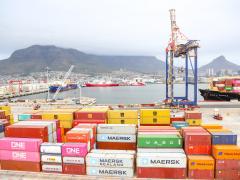
Contingency measures swing into gear Ray Smuts MASSIVE GROWTH in container volumes at the Port of Cape Town has led to stack space requirements being effectively brought forward by five years. Terminal manager Ian Bouwer told FTW last week that a 1995 forecast put probable growth at between 3,5% and 5% due in the main to some negative growth between 1996 and 2000. But with 450 000 TEUs being handled in the 2001/2 period the growth percentage has shot up to 24%. Bouwer readily concedes that these past few months have been tough on all, not least his 580-member staff complement who rose to the occasion, but he is optimistic that things can only get better as a host of measures designed to counter the problems of the past have swung into effect. Around 50 additional staff, mainly straddle carrier operators, were to have commenced duty by week’s end and two stackers capable of stacking seven high rather than the current equipment’s two high capability, brought in on short-term lease.( A request has been put forward for equipment that can stack four high.) The terminal’s proposed R250 million Ôshopping list’ for the next eight to ten years includes three cranes and around four additional straddle carriers per crane. Quay moves can be expected to increase by around 75 000 per year for each additional crane coming on stream. The decision to allocate vessels carrying less than 120 containers to the combi-terminal is expected to ease pressure somewhat on the container terminal and a number of lines including Safmarine are already making use of this facility. By last Wednesday all but around 800 containers remained in the terminal, the rest having been moved to stacking areas 619 and 618. The terminal is handling about 36 000 containers a month and predominant growth has been in empties (29,7% of the total) and transhipment cargo. The terminal was full with only one vessel lying at anchor and Bouwer was able to say: “We are berthing them on arrival and the situation has improved dramatically in the last week where, for the first time in about four months, we did not have a vessel on the berth from 14:00 to 22:00.” As to the rapid growth in TEUs between 2000 ands 2001, Bouwer says there was no indication or “pre-warning” whatsoever by the shipping companies. Cumulative TEU growth between 1995 and the present stands at 44,2%, with 456 000 containers being handled in 2001 in contrast with 303 000 in 1995. “Theoretically, our terminal capacity sits at 420 000 TEUs and this was exceeded by 37 000 last year. With an 8% growth for this year we’re going to beat that by about 70 000 TEUs, taking us up to 494 000 - hence the need for short-term solutions.” Quoting from international norms, Bouwer says most container terminal operators consider 50% berth occupancy as the maximum level that would provide an acceptable service to ship operators but probably with a realistic safe maximum of 60%. “Due mainly to the high demand at the container terminal, we were at 72% for March which is considered unacceptable by international norms. We will probably stand at around 60% by the end of this month (June) but we should ideally be between 50% and 60%.” Productivity per single crane currently stands at around 15 moves per hour but Bouwer would like to see this increase to more than 20.
Revised forecast advances CT's expansion plans
Comments | 0
© Now Media. This content is protected by copyright and may not be adapted or republished. If you would like to discuss cooperation opportunities, please contact: editor@freightnews.co.za.