Early estimates show South Africa can significantly reduce carbon emissions by cutting road freight by nearly half.
According to Professor Jan Havenga of the logistics department at the University of Stellenbosch, the first high-level estimates indicate the country could reduce the 16.8 million tonnes of road freight carbon emissions by 7.8 million tonnes leaving it with around 9 million tons.
“The research is ongoing, but it is clear that we have 7.8 million tons of carbon emission too much on our roads and we need to get rid of it sooner rather than later,” he said. The total transport emissions in the country are currently estimated at around 47.2 million tons of which 26.2 million is attributed to passengers and 21 to freight. At least 16.8 million tons of the 21 million tonnes of freight carbon emissions is road freight.
“One of the ways of reducing the freight contribution is to reduce the kilometres that trucks drive,” said Havenga. “Our current estimate is that 3 billion of the 12 billion kilometres driven annually can be reduced by shifting it to rail and another 3.6 billion by simply introducing more efficient logistics operations. Better logistics will include improved routing and scheduling, load factors and logistics efficiency in general. The remaining 5.4 million kilometres should have then improved simply through emission efficiency related to truck technology and driver behaviour.”
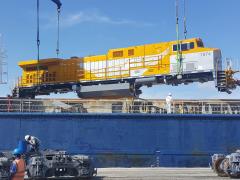
Despite the country’s road freight strategy aimed at moving more cargo to rail and much effort being made to improve rail efficiency and reliability by Transnet Freight Rail, many cargo owners are still sceptical about a road to rail strategy. According to Havenga not only is it important to move cargo from road to rail, but it is also imperative to move commodities such as high-value goods and fast-moving consumer goods.
“The focus is mostly on moving bulk heavy haul cargo to rail, but it has to be a much broader approach.” According to Havenga the country has seen decades of investment into national highways while provincial roads feeding the rail network have deteriorated. “The rail service levels have declined significantly over the years, but I do believe that there is turnaround at the moment and it is changing,” he said. According to Professor Dave Cebon from the University of Cambridge in the United Kingdom, rail solutions are more attractive from a carbon emissions point of view, but that requires an efficient service.
“Rail has a much bigger role to play in Africa and India than in the UK,” he said. “If one is talking about sustainability in the road freight sector, however, rail logistics has to be part of the big picture for road freight. “There is plenty of cake to go around for all the modes,” said Cebon. “But it is about having the best system and that does not for one moment mean that all freight must be on road.”
Our current estimate is that 3 billion of the 12 billion kilometres driven annually can be reduced by shifting it to rail. – Jan Havenga