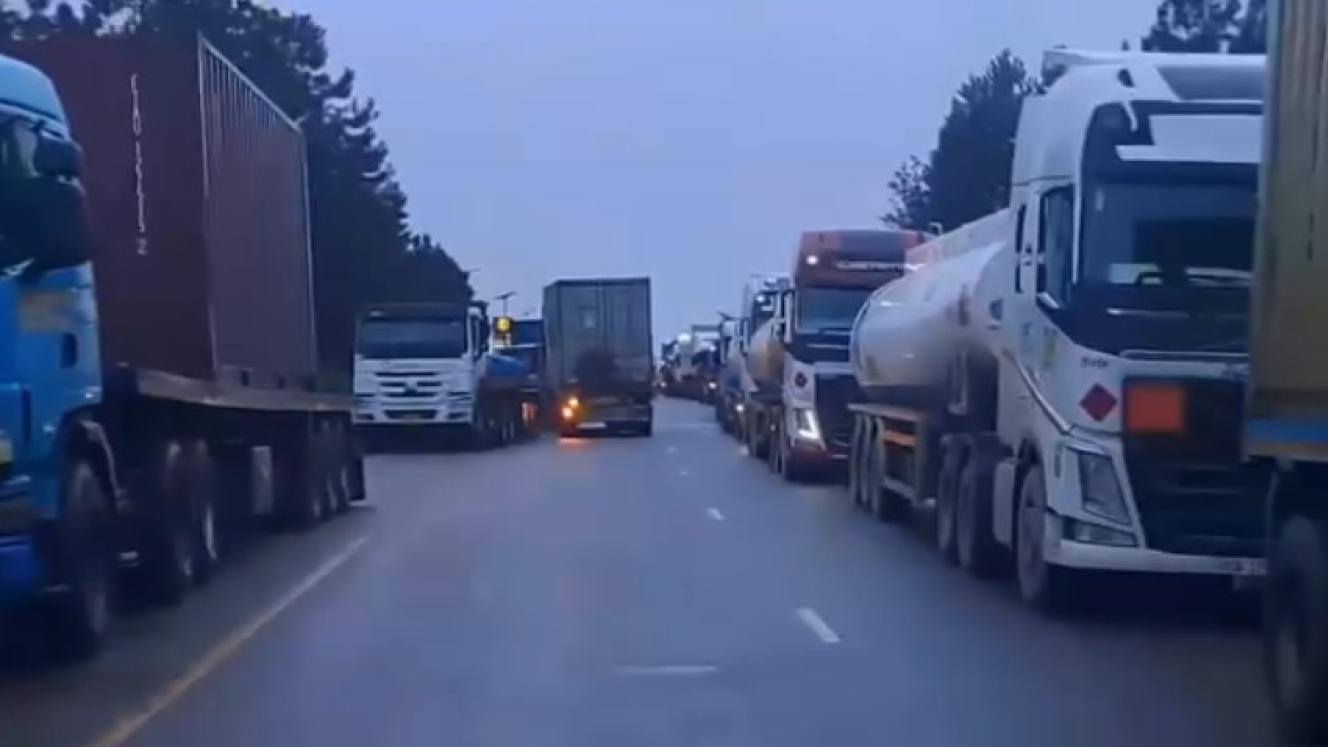
Systems failure and subsequent slow processing of cargo flowing into Zambia are causing serious bottlenecks, with reports coming through on Monday morning that at least 640 trucks are waiting to proceed north across the Zambezi.
And that’s just at the Kazungula One-Stop Border Post (OSBP), said Mike Fitzmaurice of the Transit Assistance Bureau (Transist).
At the time he spoke to Freight News, Fitzmaurice said some transporters were waiting about seven days to enter Zambia, standing in a backup of some 11 kilometres stretching south into Botswana.
He said from the weighbridge at Kazungula, about five kilometres from the actual border, the queue was a double line, which means it was at least 17 kilometres long.
Calculating the cost related to waiting time at Kazungula, Fitzmaurice said it was about $550 per truck per day.
Considering the number of trucks stuck at the important transit, primarily used by trucks serving Copperbelt clients on a bypass route avoiding Zimbabwe because of cargo complexities in that country, he said the road freight industry was losing about R5 808 000 per day at Kazungula.
Because waiting time is caused by a Payment Registration Number (PRN) issue experienced by Zambia Revenue Authority (ZRA), several other hinterland routes are also affected – Nakonde (Tanzania), Chirundu (Zimbabwe) and Mwami (Malawi).
Fitzmaurice said no matter which one of the ports transporters were using – Walvis Bay, Durban, Beira or Dar es Salaam – “if you’re taking cargo to the DRC (Democratic of the Congo) or Zambia itself, the whole network is gridlocked”.
He said the delays had started at least 14 days ago when the payment portal went down.
It was restored within three days, but left the PRN system inaccessible to the transporters to generate PRNs, causing a serious backlog that ZRA seems incapable of dealing with.
PRNs can now only be generated by a customs officer, and drivers have to queue to get the numbers.
Due to the number of PRNs that are outstanding, ZRA seems to have confirmed, as per information shared on Transit’s WhatsApp group, that it’s not keeping pace
When the slow processing forced Fitzmaurice to intervene on behalf of industry, he was told to follow protocol.
“I first raised my concerns with the regional manager (of the ZRA), then the manager of the southern region, then the Commissioner of Customs, Trade and Industry, but nothing has happened.
“They don’t seem to have any recourse to what’s currently happening and claim that trucks without pre-cleared cargo are part of the problem, which is not the case.”
Fitzmaurice said that ZRA’s excuse that cargo which hadn’t been pre-cleared was not allowed entry to Zambia was incorrect, as the OSBP Act clearly states that all vehicles must proceed directly to the country of entry and must not stop in the transit country, irrespective of their clearing status.
“So pre-cleared or not, they cannot, in terms of the OSBP Act, deny entry to the country on the basis that it is not pre-cleared.”
He said queuing was permissible based on high volumes, but the queue must flow and not be stagnant for long periods of time, which is not the case at Kazungula.
“They are completely overwhelmed and can’t cope. When trucks with pre-cleared cargo jump the queue to proceed to cross into Zambia, they get fined by Botswana Traffic Police for reckless driving and sent to the back of the line.”
Is there a sign from the ZRA about how PRNs can be fast-tracked and the backlog cleared?
“No,” says Fitzmaurice.
“There is no plan in place at this stage that has been announced, and the public announcement made by the Commissioner General that all penalties related to the delays would be waived does not go far enough to clear the backlog at all Zambian ports of entry.”
Landlocked Zambia’s current customs portal problems come at a difficult time for its own copper-mining interests and those of the DRC, dependent on its southern neighbours for transit logistics to the various ports.
Copper mining has contracted by 1.4%, but the war in the Middle East, especially Qatar’s energy extraction shutting down because of Iranian missile and drone strikes, has caused the commodity’s price to spike to $13 000 per ton.
Fitzmaurice says its supply flows coming in and those in transit that are affected, not export commodities out of Zambia on the backhaul. Nevertheless, the customs gridlocking comes at a trying time for Zambia and the DRC’s copper mining industry.