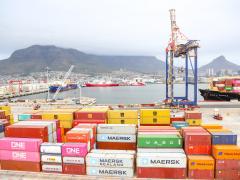
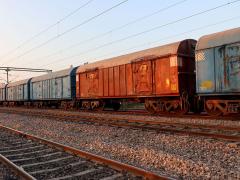
If you want to run a successful trucking operation in southern Africa, you have to extend your own tentacles into the neighbouring states with which you deal, according to TCS Logistics MD Rogan Brent. “You have to create an owned network of facilities and people if you want to work your vehicle fleet in a selfcontrolled environment,” he said. Following that same basic philosophy, his now 13-year-old Durban-based company has established infrastructure in Durban, Johannesburg, Messina, Beitbridge, Harare, Lusaka, Chirundu, Mwanza and Blantyre – with offices and workshops at all these centres. “Our fleet owner sub-contractors rely on that infrastructure for all breakdowns, clearances, fuel, tyres, and maintenance,” Brent added. And the total fleet – including Brent’s self-owned lowbed fleet of 10 rigs varying between 40 and 70-ton capacity – musters up about 200 trucks and trailers. Some 85 of these – ranging from general cargo and fuel to abnormal load outfits – belong to TCS’s main contractor, the Zimbabwe-owned Tauya. “About another 100 that we manage belong to other dedicated subcontractors,” said Brent. “Our bread and butter is, and always will be, containerised cargo. But we also handle food aid, fuel and other hazardous cargoes – and an extensive business in hauling abnormal loads into Zimbabwe, Zambia, DRC, Malawi, Mozambique and Botswana.” And the entire fleet is tracked, traced, monitored and managed electronically – with tracking stations based in Durban, Johannesburg, Beitbridge and Harare, all manned by dedicated personnel. The management of documentation is a huge factor in the business life of TCS, according to Brent. “But, from the actual point-ofsale, where we raise the order for the transporter to pick up, to the final acquittal point, all the documentation is handled through our database – a system designed internally by a specialist computer programmer on our staff. “When this process is completed, the relevant details are transferred straight into the accounting system, which automatically invoices the client.” This electronic system generates over 60% of the company’s documentation and invoicing, and Brent is in the process of putting it into a software package, which he intends to sell to other similar operations. TCS also has investments in property holdings, including warehousing. “This all ensures that we’re diversified, but still with transport as our core business,” said Brent.
Own offices add muscle to overborder service offering
Comments | 0
© Now Media. This content is protected by copyright and may not be adapted or republished. If you would like to discuss cooperation opportunities, please contact: editor@freightnews.co.za.