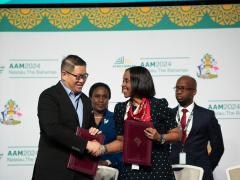
After breakthroughs in the removal of non-tariff barriers to the Chinese market, the Department of Trade, Industry and Competition (dtic) is focusing on India, with negotiations having started in September 2007, according to the department. South Africa, through the Southern African Customs Union (SACU), is negotiating preferential tariffs on selected goods. SACU and India signed Terms of Reference in August to restart negotiations for a Preferential Trade Agreement. Sanitary and phytosanitary (SPS) requirements, customs, standards and rules of origin are included in the negotiating agenda. A 2004 SACU agreement requires the customs union to negotiate all trade agreements as a bloc, according to the dtic. The “inexorable change in the economic geography of the world economy requires more purposeful effort to diversify South Africa’s trade and investment relations to benefit from the rapid and dynamic economic growth in the Global South,” says the dtic on its website. “The department, along with other departments in government, has made an ongoing contribution to the India-Brazil-South Africa (IBSA) initiative, particularly in negotiating PTAs with MERCOSUR and India. “With regard to the People’s Republic of China (PRC), the department leads an engagement to implement the Partnership for Growth and Development (PGD) that aims to promote value-added South African exports to China and increase inward investment in projects for beneficiation.” Our objective is to ensure the sustainability and mutual benefit of the relationship with this important trading partner,” it states. The most significant progress has been with China. In June, South Africa and China signed Memoranda of Understanding (MOUs) dealing with regulatory compliance and standards. They are centred around the alignment of rules and standards to support the implementation of the temporary Chinese zero-tariff policy for African imports. Speaking at the signing ceremony, Trade, Industry and Competition Minister Parks Tau said South Africa’s position was clear; trade facilitation must not mean lowering standards. “It must mean improving systems, reducing unnecessary duplication and ensuring that technical requirements are applied in a way that supports both economic development and public welfare. “There is a difference between reducing unnecessary barriers and abandoning the integrity of our technical requirements. Every time a product crosses a border, it must demonstrate compliance,” he said. “A practical outcome of the agreement should focus on priority trade sectors where duplicate testing is creating unnecessary cost and delay; undertaking technical comparison work on applicable standards and conformity assessment procedures; strengthening regulator-to-regulator and accreditation-body-to- accreditation-body engagement; and establishing a practical mechanism through which issues affecting the acceptance of accredited results can be raised, assessed and resolved,” he said. There are, at present, no similar negotiations under way between SACU and the other important markets of Bangladesh, South Korea and Taiwan. Barriers include differing technical standards, SPS requirements, rules and administrative procedures and licensing requirements for certain products. ER
NTBs remain a major constraint
Comments | 0
© Now Media. This content is protected by copyright and may not be adapted or republished. If you would like to discuss cooperation opportunities, please contact: editor@freightnews.co.za.