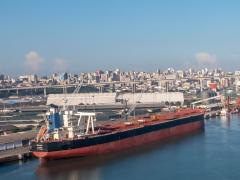
A business model of Transnet’s Durban Container Terminal (DCT) has just been forwarded to FTW, designed to show how relatively impressive performances at the waterside and landside ends of the business are seriously constricted by a narrow pipeline – illustrating the time-consuming queues of trucks that build up waiting to get into the DCT ‘A check’. Designed and built for Kevin Martin, chairman of the Durban Harbour Carriers’ Association (DHCA), it is the complete opposite of a model of the perfect logistics chain – which is normally given as a pipe of the same diameter, allowing what flows in to go out at the same flow rate. “After many years of bumping heads with various DCT management teams,” he told FTW, “I decided to build the business model of the logistics chain at DCT to show everyone what they had managed to achieve to date for all the billions spent. “Like DCT, I built my model out of very expensive materials – stainless steel instead of plastic or mild steel – to drive home the point that throwing money at a problem does not make it any more workable.” And the narrow pipe of congestion at the terminal is only going to get worse, according to Martin. “We find ourselves in the unfortunate position that, as from January 2012, for a potential 72 months, we will be losing a berth for rail installation and berth deepening on a rotating basis,” he added. “This means that 400 000 containers per year or 33 000 per month will be lost in capacity to DCT. “Yet no extra capacity has been provided – not even at Ngqura – in the years leading up to now. Did they not realise that with the harbour mouth widening berths would have to be deepened? This is crisis management taken past the extreme to the ridiculous.” Point and Maydon Wharf are being looked at to assist. “But,” questioned Martin, “does Durban really need a further 16 000 vehicles per month to run into EACH of these already congested road facilities?”
No relief in sight for congested DCT
Comments | 0
© Now Media. This content is protected by copyright and may not be adapted or republished. If you would like to discuss cooperation opportunities, please contact: editor@freightnews.co.za.