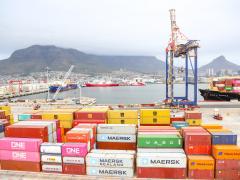
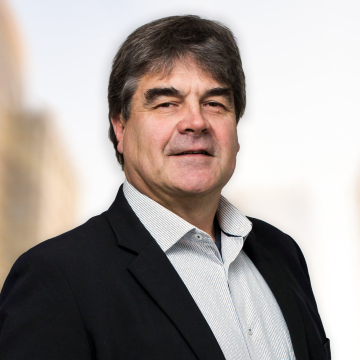
Substantial changes lie ahead as the international shipping industry adjusts to a new and unexpected world order – a prime example of how the best strategic planners in the world sometimes get it completely wrong. “Incredible volumes of ships have been ordered worldwide that now can’t be financed because of the credit squeeze,” says Deutsche Afrika-Linien director liner services, Michael Davies, who predicts a period of uncertainty and further consolidation as the impact of the financial crunch plays out. A lot of lines, especially those in the eastwest trades, could be extremely vulnerable. Some have a lot of exposure, having chartered long-term at very high rates, or having ordered newbuildings when the newbuilding prices peaked. “I expect that when the results come through for the second half of this year a lot of lines will be in the red. We’re then likely to go through a phase where there will be a substantial cooling off of the world economy – and lines will have to be a bit more realistic in their forward planning,” he said. “The next few years will be very difficult times in liner shipping.” For DAL, whose main trades are fairly static, its growth forecasts have been far more conservative than most. “We didn’t expect growth on the trades on which we are primarily active, which is why a review of growth prospects has not yet been necessary. “But that said, no-one will escape the global meltdown as it will affect everyone,” says Davies. The shipyards, for example, have had full order books but now, due to cancelled orders, we can expect newbuilding prices to fall. Similarly, shrinking consumer consumption and reduced investment expenditure due to credit restraints will affect demand for space, and lines who have committed to substantial additional tonnage will find themselves with a lot of unnecessary capacity. It’s at times like this that smaller, financially sound companies like DAL are in a strong position, in Davies’ view. “We don’t have exposure on the big eastwest trades and we are convinced that if we keep tight control of our costs and continue to maintain what we consider to be our main selling points – which are amongst others to offer customer-orientated services – we’re well placed to ride out the storm. And while in difficult times every company has to tighten its belt, DAL’s owners – with their diversified activities in the chemical tanker business – will be looking for opportunities, says Davies. “Other companies that find themselves in difficulties could be up for grabs – and whether it’s the companies or the ships, DAL will be on the look-out for opportunities. “The recent demise of SA Independent Liner Services illustrates how difficult it is for a newcomer to establish itself in a trade like SA which is not very big.” Looking at the broader picture, port infrastructure problems will continue to be a challenge for carriers. “There are very few ports in the world that have the capacity and capability to deal with the megacontainer vessels or trades which require such capacities. “It’s very similar to the airline industry – where you have major routes covered by the global airlines with the super large aircraft like the Airbus 380 operating between major hubs. But there are a lot of small, regional operators on direct routes where only limited capacity is required. Nevertheless it is important that all ports are efficient and provide both the shipping lines and their customers with the required cost-effectiveness and service levels,” said Davies. “DAL is not looking specifically at new market areas at the moment – we will concentrate on what we are doing but follow up on any opportunities when they arise,” says Davies. The dissolution of the SafDAL agreement and establishment of the DAL Agency organisation in South Africa provides a new beginning for DAL in South Africa. It could start looking at vertical opportunities, for example, in the agency arena like representing other lines through the newly established network. The challenges of the world’s changing fortunes clearly present a host of opportunities for financially sound companies with the vision to capitalise on the new set of circumstances.
‘No-one will escape impact of global meltdown’
Comments | 0
© Now Media. This content is protected by copyright and may not be adapted or republished. If you would like to discuss cooperation opportunities, please contact: editor@freightnews.co.za.