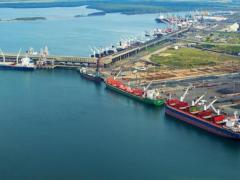
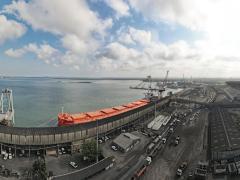
Maydon Wharf Terminal targets China TERRY HUTSON THE OPENING of a new R61.5 million fruit terminal on Maydon Wharf will significantly boost South Africa’s chances of increasing citrus exports to countries with strict import protocols. Last year South Africa exported 120 000 pallets of citrus to Japan, which has one of the strictest steri-protocols. The new Maydon Wharf Fruit Terminal, a 70/30 joint venture between the Oceana Group and SA Port Operations, handled 35 000 pallets of this volume – the balance going via another Durban facility, Fresh Produce Terminals. Guests at the opening last week were told that the Maydon Wharf Terminal was likely to increase its throughput to 67 000 pallets this year and was also targeting the Chinese market. Local citrus producers are keen to break the stranglehold that other countries, notably the United States, have on the Asian market. An estimated 26 million trees have been planted locally in the last eight years and an additional 30 million cartons of citrus should become available by 2010, boosting the total to 100 million cartons and leaving producers to find new export markets. Currently 75% of South African export production is sold into central Europe and the UK with SA also developing an emerging market in Russia. Sales to the Middle East have grown by between 30% and 40% since 2001. The Department of Trade and Industry forecasts that fruit exports to the UAE will double by the end of next year’s season. China has become one of the big hopes for fruit exporters, following the signing of protocols between South Africa and China in mid 2004 that formally provide access to the Chinese citrus market. The Citrus Growers' Association said last year that China would be treated as a special market, with those wishing to export to China having to register their orchards and apply steri-treatment to eradicate unwanted pests. Which is why the new Durban terminal is likely to come into its own, along with the existing Fresh Produce Terminal on the T-Jetty. Both terminals leave Durban well secured to maintain its position as the principal citrus export port.
New facility sets stage for Asian market breakthrough
Comments | 0
© Now Media. This content is protected by copyright and may not be adapted or republished. If you would like to discuss cooperation opportunities, please contact: editor@freightnews.co.za.