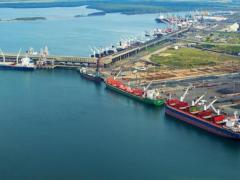
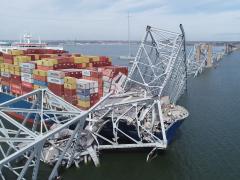
THE LATEST controls on ship pollution proposed by the International Maritime Organisation (IMO) will have no direct impact on the SA ship-owning community, according to Andrew Thomas, CEO of Ocean Africa Container Line (OACL). Only that Grindrod line and the Lonrho-owned SA International Liner Service (Sails) are SA-registered. “And both,” said Thomas, “have chartered fleets, so the onus is on the owners to have ships which comply with the new emission control deadlines.” The new controls, which lay down acceptable emission caps for the maritime industry and dictate future ship engine designs, are contained in the Marpol Annex VI Regulations for the prevention of air pollution from ships. It entered into force in May 2005 and has, so far, been ratified by 49 countries, representing approximately 74.77% of the gross tonnage of the world's merchant shipping fleet. “And,” said Maria Tierney of Cockett Marine Oil SA, “the proposed draft amendments to Annex VI and the NOx Technical Code will now be submitted to MEPC 58 (which meets from October 6 to 10) for adoption, in accordance with an agreed timetable. This would see the revised Annex VI enter into force in 2010.” The work on greenhouse gases is scheduled for completion in 2009, in time for IMO to submit a position paper to the Copenhagen Conference (December 2009) called for by last year's Conference in Bali on climate change. ”Following intense efforts to find a workable solution on a matter that had been highly controversial and the subject of extensive debate in its air pollution working group,” Tierney added, “the committee agreed with a series of progressive standards in the amended regulation 14 sulphur oxides (SOx) and particulate matter (PM) that would result in significant reduction of SOx and PM emissions from ships.” The main change, according to the IMO, is a progressive reduction in SOx emissions. This is designed to see the global sulphur cap reduced initially from the current 4.50% to 3.50% – effective from January 1, 2012. In the next eight years this figure will progressively sink to the 0.50% limit effective from January 1, 2020. The limits applicable in IMO-designated sulphur emission control areas (Secas) would be reduced from the current 1.50% to 1.00% – beginning on March 1, 2010. It is then to be further reduced to 0.10 % – effective from January 1, 2015. In the current Annex VI, there are two Secas designated – the Baltic Sea and the North Sea area (which also includes the English Channel). Similarly, the MEPC has also agreed to progressive reductions in NOx emissions from marine engines. The most stringent controls are on socalled “'Tier III”' engines – those installed on ships constructed on-or-after January 1, 2016, and operating in emission control areas. The primary effect of these on the global shipping industry will be that they will cause a lot of head scratching at line head offices around the world, according to Thomas, as management plans its vessel ordering and alteration schedules. It is likely to see a general rise in shipping costs as smarter ships cost more bucks, Thomas suggested. It also going to mean a need for cleaner fuel than the current “bottom of the barrel” heavy fuel oil currently powering the marine industry. And smarter fuel will also cost more.
New emission controls dictate future ship engine designs
Comments | 0
© Now Media. This content is protected by copyright and may not be adapted or republished. If you would like to discuss cooperation opportunities, please contact: editor@freightnews.co.za.