South Africa’s container volumes are once again bucking the global trend as global container volume growth is expected to swing up to around 3.2% and even higher in sub-Saharan Africa in 2018.
That was the message from Transnet Port Terminals head of strategy, Willie Coetsee, who outlined container and automotive export prospects at a recent transport conference in Durban.
Coetsee said the United Nations Conference on Trade and Development had projected seaborne global container volume growth to hit 3.2% between 2018 and 2022 – up from a slump of 2.6% in 2016 and 1.8% in 2015. He said the downward trend had moved from a level of 3% global growth between 1974 and 2014.
Coetsee said only about 2% of world seaborne traffic came through South African ports and the country was not likely to grow at the same rate although predictions for sub-Saharan Africa were around 3.9%.
“The bottom line is over the last four to five years container volumes have stagnated in not just SA but in Africa, so it is starting to pick up. Places like Kenya and Tanzania are expected to grow at high levels, obviously from a different base than South Africa. Mombasa’s rail connection is creating capacity and Tanzania with their new president is starting to make inroads and have some good growth,” Coetsee said.
“Mauritius is very real competition for Ngqura and Walvis Bay has created a new container terminal with 750 00 TEU capacity – so keeping all of these things in mind our container volumes are going to grow, but at a slower rate than the rest of the continent,” Coetsee said.
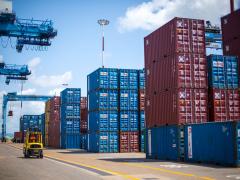
Durban port moved container volumes of 2.6 million TEUs, Cape Town 926 600 and Ngqura 571 000 in 2016 compared to Mombasa which moved one million and Port Louis which moved 511 000 in the same year.
However, he said the positive news was that the IMF had adjusted its growth projection for South Africa up to 1.5%. And South Africa had improved its ranking on the Logistics Performance Index from 28th in the world in 2010 to 20th in the world in 2016. The index rates countries for port and customs efficiency, pricing competitiveness, infrastructure, quality of logistics services and timeliness of shipments.
Coetsee added that automotive industry exports were expected to be another driver in port trade volumes during the next few years.
“Thirty-seven percent of all new cars sold on the continent are sold in SA and 80% of the cars that are manufactured in SA are exported through our ports,” Coetsee said.
“In SA 6.7% of GDP comes from newly manufactured cars. If you add trucks and automotive parts, about 10% of the GDP comes from this industry, so this is a very important industry, not just in terms of cars we export.”
Coetsee added that Transnet was continuing to invest in port infrastructure to keep pace with anticipated volume growth.
He said R18 billion had been spent on new equipment and resurfacing as part of the parastatal’s market demand strategy since 2012.
He said work on the expansion of Durban port’s Berth 203, 204 and 205 would start in September. The project will expand the berths by about 50m into the sea, with draughts of 16m and lengthen the quay wall from 900m to 1.2km to accommodate longer vessels. The project to infill Pier 1 would create capacity of 2.1 million TEUs.
Anticipated container volume growth was in the region of 5.4 million TEUs per annum once the Pier 1 infill and berth extension projects had been completed, he said, adding that the port was working closely with the city on its integrated transport plan to accommodate traffic growth and was harnessing technology to enhance port efficiency.