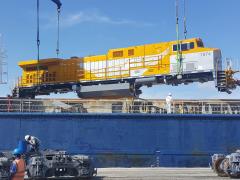
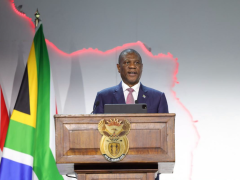
Last week’s signing by Barloworld Logistics of a memorandum of understanding (MoU) with Transnet Freight Rail (TFR) aimed at multimodal cooperation is seen as a longterm strategy. “It’s definitely not tomorrow,” Barloworld marketing executive Kate Stubbs told FTW. “But there is certainly a greater sense of them internally trying to make things work.” “We are going to react more constructively and formally with TFR from now on,” Stubbs said. “And they are definitely trying to work towards a better rail solution, and drive a strategy to get more productivity into rail – using the likes of information technology (IT), planning solutions and integrated systems.” TFR is also busy with a fleet recapitalisation exercise. This is supported by almost R200 billion targeted at rail-related investment in Transnet’s R307.5bn capital investment plan to 2020. Bids for the supply of 599 electric and 465 diesel locomotives are currently being adjudged, with TFR having already taken delivery of, or placed orders for, various other locomotives. Its wagon fleet is also being upscaled, with TFR anticipating the addition of more than 2 800 wagons in the current financial year. Barloworld CEO Steve Ford said that, despite its heavy reliance on road, the company had always maintained an agnostic stance with the transport platforms it used. Rail made sense in light of the “enormous” distances that goods needed to travel in SA to reach areas of demand, he added. He also expected material savings from the proposed multimodal strategy. “We strongly believe that moving the right product onto rail will make significant impacts on the cost of distribution,” Ford said. And the right product, according to Stubbs, is bulk goods. “Although it’s quite open, with standard containerised cargo and automobiles included, that’s the way we’re looking at present,” she said. Although the primary route still remains the Gauteng-Durban corridor, Barloworld is also looking at other long-hauls around the country. “It all depends on what our clients need and where they want us to distribute,” Stubbs said. “It also obviously depends on the price and efficiency that the clients can gain from such a multimodal exercise.” The big thing about this new relationship – where Imperial Logistics has also signed up an MoU with TFR – is that it’s an “industry solution”, according to Stubbs. “It also has to be taken into account that rail has traditionally been the more cost-effective and environmentally-friendly mode,” she said. “It will also be extremely encouraging to be able to work closely with TFR on their future development strategies.” Ford added that the envisaged partnership with TFR should improve Barloworld Logistics’ business sustainability, as well as the sustainability of the country’s transport system. INSERT & CAPTION 1 Barloworld has always maintained an agnostic stance with the transport platforms it uses. – Steve Ford INSERT & CAPTION 2 Bids for the supply of 599 electric and 465 diesel locomotives are currently being adjudged. – Siyabonga Gama
Multimodal strategy gains momentum
Comments | 0
© Now Media. This content is protected by copyright and may not be adapted or republished. If you would like to discuss cooperation opportunities, please contact: editor@freightnews.co.za.