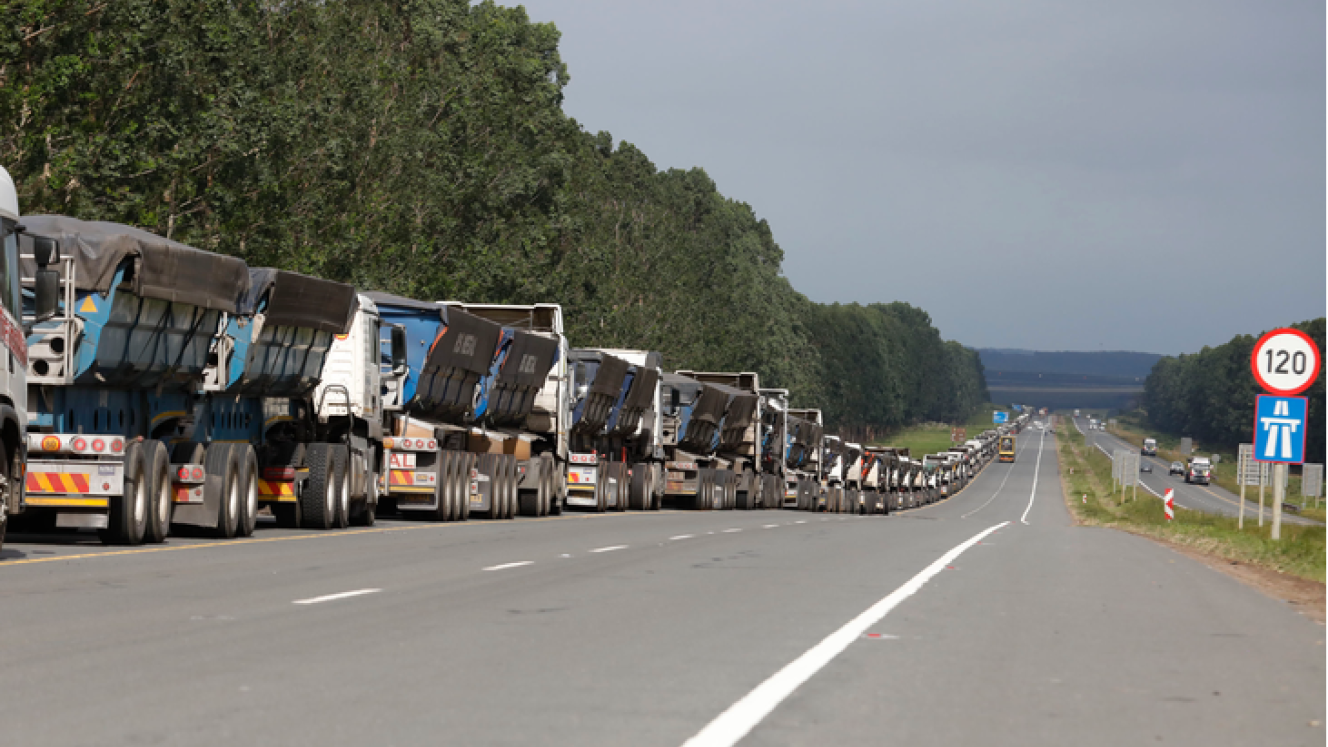
A formal complaint by a Durban motorist about coal trucks blocking the N2 corridor into Richards Bay has brought renewed attention to the long-running Gate Zero controversy, with transporters arguing that the system leaves them with few alternatives for staging while law enforcement agencies insist they are acting.
Kamal Lil-Ruthan, a concerned motorist, described the situation as both "unacceptable and dangerous".
He alleged that heavy trucks were routinely parked on the solid white line, yellow emergency lane and road shoulders "in disregard of the National Road Traffic Act".
"What is even more concerning is the apparent 'different strokes for different folks' approach to enforcement. Private motorists are routinely fined for stopping with wheels over a line, yet the same standards appear not to apply to coal trucks," Lil-Ruthan told Freight News.
He also highlighted trucks occupying all three lanes while overtaking and claimed RTI officers were sometimes seen "engaging casually with drivers while no enforcement action is taken".
He said the route was gaining a reputation as a "hell run" because of congestion and safety risks, and he was concerned about the potential impact on tourism in Richards Bay, St Lucia and greater Zululand.
KwaZulu-Natal Department of Transport spokesperson Ndabezinhle Sibiya rejected the allegations.
"We reject the allegation. RTI intercepts trucks every day, and Umhlathuze Traffic is actively managing trucks transporting coal to the port," he said.
Transporters argue the queues are linked to the Gate Zero staging facility and broader port bottlenecks.
Gate Zero, which opened in December 2024 and is managed by an external property group, requires operators to pay an access fee – previously reported by Freight News at about R157 per truck – before they can proceed to the port or offloading points. Industry bodies have previously questioned the lack of due diligence, the presence of high-voltage Eskom lines over the site and the continued gravel surface, estimating that tens of millions of rand may have been collected while conditions remain poor.
Elmarie Kleyn of Kireni Logistics told Freight News on Monday that trucks were routinely stopped for inspections along the N2 from Ermelo to Richards Bay.
"But when it comes to Richards Bay, where trucks are stuck on the N2, and there are two or three lanes of trucks waiting to go through Gate Zero, there's nothing we can do about that, and law enforcement cannot fine trucks for standing on the N2 because trucks cannot pass through to the port or offload outside the port," she said.
"So where else are the trucks supposed to go? We're forced to queue on the N2 because there's nowhere else to wait, and it's not our fault."
Kleyn said transporters had previously been able to bypass Gate Zero to offload at facilities outside the port, but that option had been closed.
"All of this goes back to Transnet's inefficiencies," she said.
Nico Erasmus of Thermal Ice Trading echoed the frustration.
"There should be a staging area, but why should transporters have to pay to use it? There's a staging area in Durban harbour that operators can use free of charge," he said.
He also alleged that some operators were able to bypass the queue using pre-paid tickets.
"The harbour is a mess. It's not being maintained properly. I lost four tyres last week, at a cost of about R8 000 each, because of the poor road conditions. It's a weekly occurrence to lose two or three tyres because of the condition of the roads and the amount of standing water," Erasmus said.
Road Freight Association (RFA) CEO Gavin Kelly has previously echoed these concerns, warning that deteriorating infrastructure was placing significant financial pressure on operators.
"The financial toll is severe and quantifiable," Kelly said. "A fully tyred truck-and-trailer combination carries between 18 and 22 tyres, each costing about R14 500. Operating on degraded gravel and through standing water can reduce tyre life by a third or more. Across a fleet of just 10 trucks, that represents an unbudgeted cost of R2.9 million or more."
The South African Freight and Logistics Association (SAFLA) has also previously warned of the broader economic impact.
"The financial consequences of this deterioration do not remain isolated within the trucking fraternity. They cascade directly into the cost structures of the broader logistics chain," SAFLA executive officer Dave Logan and vice chair Jonathan McDonald told Freight News in June.
Transnet last month distanced itself from the Gate Zero system. However, official documents indicate the state-owned company played a key role in establishing and implementing the system, despite later stating that the facility fell outside the port precinct.
The City of uMhlathuze had not responded to questions at the time of publication.