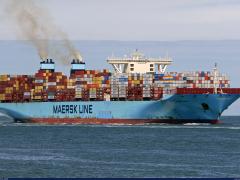
AS THE global transport sector continues to labour under profit-sapping operational costs, not least the price of fuel, Maersk Line’s Mark Cairns is nevertheless fairly sanguine better days could well lie ahead. Let us hope he and others are right, for the prospect of oil hitting US$200 a barrel is simply too awful to contemplate. “Were it to reach those heady heights, there could be be a slow-down in global trade and changed sourcing patterns,” says Cairns, the carrier’s director for sales and reefers in South Africa and Namibia. What he is fairly certain of is that the days of US$70 p/b and up to the US$100 p/b level are gone, and that US$110 p/b would seem more realistic, which is in line with a forecast by respected media organ, Containerisation International. “If one looks at bunker prices in Cape Town over the past four months, they have moved from around US$560/ton to more than US$800/ton and will hopefully stabilise for the next few months, after which we will just have to wait and see.” The roll-out of the AP Moller-Maersk Group’s floating bunker adjustment factor (BAF), first proposed last year, is just about complete on all Maersk Line trades, with the exception of the allimportant North Europe/South Africa (SAECS) trade, to be implemented on October 1. (Bunker prices account for a significant portion of the group’s operating costs). Cairns explains of the floating BAF: “It is pretty much a revenue-neutral transaction, getting our customers to share in the risk of upward involvement in the oil price and the benefit of a downward movement, very much like the petrol price.” Tough conditions notwithstanding, this promises to be a satisfactory year for Maersk Line in reefer cargoes from South Africa. South African reefer growth for the first six months of 2008 was up 1% compared to 2007 and major growth markets were the Middle East and Europe, where prices remained strong and exporters diverted fruit from other markets. He expects this pattern to continue in the second half of 2008, due primarily to increased exports from certain markets into China and a market swing of some 9% in favour of containerised over conventional shipping in South Africa. Cairns does not foresee a demise of specialised reefer shipping in the medium-term, pointing to the role it plays in the huge banana trade from South America, West Africa and certain parts of the Far East, on top of which he believes that the balance between containerised and conventional cargoes will reach a point that caters for the market requirements for exports from the South African market. “As much as we will continue to build capacity out of South Africa, it's really a question of balancing capacity. This depends, of course, on the market point of view of saying that price will determine the financial viability for exporters to move product in containers. “Price and capacity will remain determining factors in the transport of perishable cargo from South Africa and we are constantly reviewing options to assist exporters to bring their fruit to market.”
Middle East and Europe markets remain strong
Comments | 0
© Now Media. This content is protected by copyright and may not be adapted or republished. If you would like to discuss cooperation opportunities, please contact: editor@freightnews.co.za.