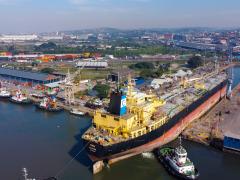
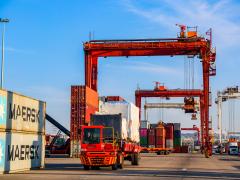
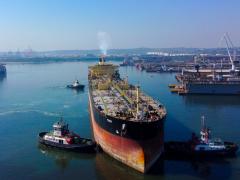
A MAJOR challenge for shipowners in the Africa trade is berth congestion throughout the southern sub-continent’s port network, according to Andrew Thomas, CEO of Ocean Africa Container Lines (OACL) – a joint-venture between Safmarine and the Grindrod group. “On average we lose 20% of our voyage days,” he told FTW, “which means one or two of the eight vessels deployed at any one time sits idle while at anchorage at one of the ports. “This blocks the supply chain and causes a huge frustration for clients whose cargoes are subsequently delayed. The cost of these delays equates to tens of millions of rands annually to us.” Angola is a prime example of this port congestion. While import market demand has grown significantly over the past year, the volumes shipped into the main port of Luanda have only increased by around 10%. “This differential can be attributable to constraints in the supply chain,” said Thomas, “where ships are waiting up to 30-days to berth. We estimate there is currently over 100 000-tonnes of cargo destined for Luanda sitting in various ports in the region and beyond.” Adding to the logistics costs in Angola is the fact that there are no containerised exports from the country. “The shipping of empty containers out of Angola attracts significant repositioning costs,” Thomas said, “which are ultimately borne by the importers.” To beat the problem, OACL deploys eight, modern, purpose-built container ships on the Southern African coast on a port circuit from Nacala in Mozambique to Luanda in Angola – and offers services in all major ports in SA, Mozambique, Namibia and Angola. Its business falls into three market segments. OACL is a “common feeder operator” – carrying containers for other shipping lines between the various hub ports and out ports where the mainline operators offer cargo acceptance but do not send vessels of their own. “Utilising our own fleet of containers we also offer cargo acceptance to shippers and consignees trading within our port range. “We also carry domestic cargo between SA ports as part of our supply chain solutions for various major SA companies.” One of the major commodity groups in this business sector is sugar – with OACL offering complete transport, warehousing and distribution services to both Illovo Sugar and Tongaat Huletts Sugar. “If you take a spoon of sugar in your coffee anywhere in Cape Town, East London or Port Elizabeth,” said Thomas, “it’s very likely that sugar will have spent some time on an OACL vessel between the sugar mill and your cup.” As part of its development, the line’s board has just approved plans to upgrade the service – acquiring a new fleet of containers purpose-built for the region, and designed to support the growing market. The line is also in a fleet replacement programme – continually deploying larger vessels of 1 100-teu capacity, and replacing the smaller 600-teu ships.
Massive berthing delays block supply chain
Comments | 0
© Now Media. This content is protected by copyright and may not be adapted or republished. If you would like to discuss cooperation opportunities, please contact: editor@freightnews.co.za.