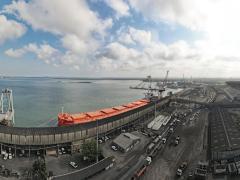
Coal exporters will reconsider rail MOVING FRESH fruit the short distance from Mpumalanga to the port of Maputo should be accomplished comfortably by an efficient rail service. But Filipe Franco, general manager of Matola Cargo Terminal (MCT), has other ideas. "Firstly it takes too long by rail. Then Spoornet has a problem on the South African side where fruit gets stolen too easily. Thirdly we find rates too high." Franco now heads an operation which trucks the produce to the port. This takes two hours from the main loading area at Malelane. With 3 100 pallet positions under cooling in the vast warehouse available at all times, the trucks move in and out in quick time, working under the wings of an associated company, MOVE, which owns the fleet, and another MCT business unit which is in charge of the fuel stations and maintenance depots. Will Franco consider switching to rail when the the rail line is upgraded between Ressano Garcia and Maputo? "Every opportunity is considered in a strict business sense, but it would have to be a big, big improvement for us to move away from road transport," he says. Coal producers, on the other hand, see the possibility of a rail infrastructure improvement in a different light. Both Carolina Coal and Kumba Coal Exporting Company, two of the major producers in Mpumalanga, are prepared to swing loads to Maputo if matters are improved. Not only an upgrade of the line but also availability of rolling stock will help them decide on any change. Both use Richards Bay for coal exports at present, but say there are ample supplies available which could move down an improved rail line to Maputo. Kumba speaks of as much as 600 000 tons which would be available annually. Other large-scale producers of possible export volumes from Mpumalanga through Maputo who are watching developments, are Sappi Mills and Foskor.
Maputo perishable exporters opt for road
Comments | 0
© Now Media. This content is protected by copyright and may not be adapted or republished. If you would like to discuss cooperation opportunities, please contact: editor@freightnews.co.za.