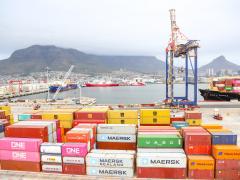
Adding value is the way ahead THE EVOLUTION of Maersk South Africa from its meagre beginnings as a two-person operation based in Penmor Towers in the centre of Johannesburg ten years ago to the major force it has become in local shipping circles today is a story of vision and commitment. The foundations were laid when Niels Strand Nielsen opened the first South African office for the world’s major shipping line in 1992. At the time it was involved purely on the Far East route as a member of the SA - Far East Integrated (Safari) service. Few people could have foreseen the rapid momentum of the company’s growth, emerging as it has after a decade as a force to be reckoned with. The post-apartheid era was a turning point for the line which had until then maintained a low profile in the country, gradually putting in place the network that would serve it in the New South Africa. A Durban office was opened in 1993, a Cape Town branch in 1994 and from there its Southern Africa network of services and offices was put into place. A major turning point, says Cape Town-based managing director Peter H. Ehrenreich, was the acquisition of Safmarine in 1999. “That’s when A.P. Moller became a significant factor here.” “In the last two years Maersk Sealand’s exports have grown 80% and imports 30%, and that in a diminishing import market. “We could do a lot more in exports, but our ceiling is the capacity on ships and the bottlenecks at ports.” It’s an issue close to Ehrenreich’s heart, and he has been a prime mover in several port initiatives designed to cut delays which he believes are stifling the economy. “Our vision,” says Ehrenreich, “is profitable growth allowing us to add value to our clients’ businesses.” And this involves getting closer to the customer and moving away from the traditional port to port role. Facilitating this move are the various A.P. Moller companies, with Maersk Logistics playing a major role in the supply chain arena. But SATI and Roadwing can also add value to the chain, says Ehrenreich. “By using all the right companies we are in a position to offer a fully fledged service from a-z.” When it comes to securing business, price is not the main issue, says Ehrenreich. “Most lines are price-competitive. What matters in this business is the people and the IT (information technology). “ Currently 10% of the line’s export business is transacted via the internet. Worldwide this figure stands at 30% and the objective by the end of 2003 is to reach 50% globally, including South Africa. The company’s competitive edge is however more than balanced by a commitment to the country as a whole. It has made a considerable investment in the Simon’s Town Maritime School and has invested R28-million in the establishment of a state of the art maritime training centre in Cape Town, due to come on line early next year. A gift to South Africa from the A.P. Moller Foundation, Safmarine and Maersk Sealand, the centre aims to enhance the maritime education and skills training of South African seafarers. Bringing a social responsibility slant to its recent golf days in Johannesburg, PE, Durban and Cape Town, the company called on its service providers to buy a hole, the proceeds of which were donated to Boy’s Town. For the future, the A.P. Moller Group has made clear its aspirations regarding port concessioning. As a worldwide major in the operation of terminals, the Group is a keen contender when port terminal concessioning comes into operation in South Africa. The contender will be a totally independent company from the A.P. Moller Group called APM Terminals. It operates common user port terminals all over the world, servicing all shipping lines. “APM Terminals, with a strong BEE partner, will become a very significant contender for future port concessions,” said Ehrenreich. Clearly the next decade is likely to be even more momentous than the last.
Maersk SA celebrates a decade of growth
Comments | 0
© Now Media. This content is protected by copyright and may not be adapted or republished. If you would like to discuss cooperation opportunities, please contact: editor@freightnews.co.za.