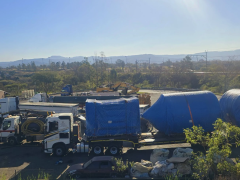
MACS Maritime Carrier Shipping is increasing capacity for the project cargo sector with several vessels on order and due to join the fleet next year. The carrier, which has offered a regular liner service between South Africa and Europe for 30 years, also represents sister company GAL in South Africa, which offers a similar service from the US Gulf. Lars M Greiner, Macs project manager southern Africa, told FTW that the current expansion of the Macs fleet had been necessary as the project cargo industry had seen tremendous growth in recent years. “We wish to continue offering sailings every 10 days so that if you miss one vessel, the next one is close behind. This keeps the project running smoothly and reduces the problem of leaving cargo waiting at destination for long periods.” According to Greiner, moves have also been made to upgrade the GAL fleet with the inclusion of more modern tonnage. “Less than two years ago Macs purchased a feeder vessel, the Black Rhino, which gives us the ability to carry specialised cargoes beyond our normal ports and to get into some of the smaller East and West African ports with limited draught. This year the Black Rhino has made calls at Cabinda and Soyo as well as Beira.” In South Africa there has been a lot of development, with many of the mining houses extending their reach into Africa, says Greiner. As this develops and continues, the project industry will grow on the back of this.” Peter Böckels, Macs project manager for Europe, says the ordering of ships is based on meeting market demands. “The newly developed ships have increased market-orientated lifting capacities as the industry is growing world wide.” He says with more wind energy installations worldwide along with the mining industry growth, the sector requires bigger volumes per shipment as heavier components are transported. He further points out that Macs has already played a key role in many large and well-known South African projects such as the building of the Columbus smelter and the BHP Hillside Smelter, with the more recent Ambatovy project in Madagascar another in which Macs participated. Both Böckels and Greiner agree that internationally units are becoming larger and more complex, requiring specialised vessels to be developed in line with this. There’s also an increased need for dedicated services and personnel to manage these moves. “In South Africa we are currently leading the way in terms of mining technology development,” says Greiner. “However, this is not yet translating into the development of the related transport for this, and we are constantly looking for ways to improve this to ensure the country does not risk being left further behind.” He says increasingly it is taken for granted that the transport industry is able to move whatever cargo comes its way. “The skills shortage in South Africa however needs to be addressed if we are to keep pace with cargo developments.”
Macs adds capacity to cope with escalating demand
Comments | 0
© Now Media. This content is protected by copyright and may not be adapted or republished. If you would like to discuss cooperation opportunities, please contact: editor@freightnews.co.za.