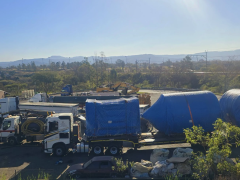
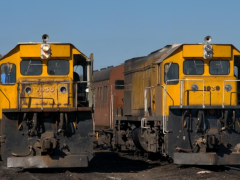
Lüderitz is on track to follow the success of Walvis Bay which has been transformed from a fishing harbour into a regional logistics gateway in 20 years. Plans in the pipeline could have a direct impact on the export of manganese ore through Ngqura, and also affect volumes of project cargo through Cape Town. Freight forwarding, shipping and warehousing companies are opening offices and building new facilities to cater for the growth. One of the catalysts for the new interest in Lüderitz Bay was the routing in August 2013 of two 335- ton heat exchangers bound for the KaXu Solar One Project site near the town of Pofadder in the Northern Cape. John Gillham, general manager of Lüderitz Bay Shipping and Forwarding (LBSF), is quoted in “Bidpeople” as saying that Lüderitz was chosen because it offered a less congested land-side route to the site. The port was able to handle the out-of-gauge cargo. “We were able to offload this large consignment within two hours, having stabilised the vessel with a port tug. The client was impressed with the operations and advised that future shipments of this nature would be headed for Lüderitz,” he added. In addition to project cargo there has been an increase in commodity exports through the port. “Lüderitz was largely written off by the mines,” says Philip Coetzee, general manager of Woker Freight Services Namibia. “But the shipping of the heat exchanger through the port has opened their eyes.” According to the Walvis Bay Corridor Group (WBCG), the Skorpion Zinc Mine in southern Namibia has been making greater use of the port, with the result that mining export tonnages now exceed those of fishing. Agricultural exports are also expected to increase, with the potential of grapes being exported from Aussenkehr in southern Namibia and the Northern Cape, according to WBCG. There are feeder services from Lüderitz to Walvis Bay and Cape Town. A further boost for volumes – and one which will provide an alternative to Ngqura for the manganese mines in the Northern Cape – is the rehabilitation of the Aus-Lüderitz railway line. Work has resumed after delays due to a lack of funding and shortage of rails. The plan is for manganese ore to be trucked to the Namibia/South Africa border, and then transferred onto rail at the Ariamsvlei/Nakop border post where the Windhoek–De Aar rail line crosses. Namport has completed longterm feasibility studies for Lüderitz, which include the building of a new deep-water harbour at Angra Point, primarily for bulk minerals from the region. These plans are being consolidated under the !Nami#Nüs (Lüderitz) Trade Corridor Initiative, which will provide a gateway for trade in Namibia, the Northern Cape and Eastern Botswana. Literally fuelling volumes on the corridor and through the port will be a 3000-ton liquefied petroleum gas (LPG) transfer and storage facility due to be built by Corridor Gas and Oil Terminal, a joint venture between Ehalo Investments of Namibia and Pula International of Botswana which was established in 2011. The company says it will be supplying gas to Namibia, Botswana, Zambia, Zimbabwe and South Africa. CAPTION One of the catalysts for the new interest in Lüderitz Bay was the routing in August 2013 of two 335-ton heat exchangers bound for the KaXu Solar One Project site near the town of Pofadder in the Northern Cape.
Lüderitz attracts strong new interest
Comments | 0
© Now Media. This content is protected by copyright and may not be adapted or republished. If you would like to discuss cooperation opportunities, please contact: editor@freightnews.co.za.