Local ports and the broader logistics sector closed out the year with improved throughput, firmer global trade conditions, and signs of sustained recovery across key corridors, the last Cargo Movement Update (CMU) for 2025 states.
However, weather-related stoppages, equipment shortages and regional border pressures continued to weigh on performance, CMU compilers, the Southern African Association of Freight Forwarders (Saaff) and Business Unity South Africa (Busa), say.
Container terminals handled an average of 11 851 TEUs per day during the week of December 1–7, up 10% from the previous week.
Total national throughput reached 82 957 TEUs, driven primarily by strong gains at the Port of Durban’s Pier 2 and Pier 1, which recorded weekly increases of 11% and 74% respectively.
The ports of Cape Town, Ngqura and Port Elizabeth all experienced declines linked largely to poor weather and berth availability constraints
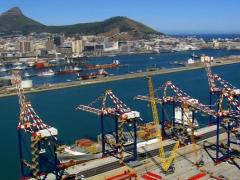
Operations in Cape Town were heavily impacted by strong winds, with more than 50 operational hours lost during the week.
Durban continued to face equipment shortages, while Richards Bay saw delays due to marine equipment challenges and adverse weather. Eastern Cape ports also reported underutilised berths and weather-related slowdowns
Looking at data by Transnet National Ports Authority, monthly figures show a more buoyant November, with container throughput rising 11% month-on-month (m-o-m) and 4% year-on-year (y-o-y), while dry bulk climbed 21% m-o-m.
Vehicle handling surged 54% m-o-m and 28% y-o-y, although liquid bulk and breakbulk volumes remain weaker on an annual basis
Rail performance out of Durban strengthened as the annual shutdown of the Container Corridor line concluded. Weekly rail volumes jumped 53% to 2 824 containers, although locomotive failures on the City Deep–Mafikeng route continued to limit optimal flow
International airfreight into OR Tambo International Airport fell sharply, with inbound volumes down 25% week-on-week (w-o-w) to around 517 000 kg per day, while outbound uplift grew 4%.
Overall weekly tonnage declined 16%, though current levels remain roughly 14% higher than December 2024 and significantly above pre-pandemic benchmarks, reflecting a still-resilient market heading into year-end
Globally, air cargo demand continues to firm. Iata data shows October CTKs up 4.1% y-o-y, with the strongest growth in Africa and the Asia-Pacific region. Capacity rose 5.1%, keeping load factors slightly softer despite higher volumes
Cross-border movement along the N4 and through the Lebombo-Ressano Garcia crossing slowed ahead of the festive season. Heavy-vehicle volumes fell 5% to around 1 281 trucks per day, while queue times edged up to 6.9 hours and processing times averaged 6.5 hours per crossing. Congestion remained particularly acute at Beitbridge, Kasumbalesa and Katima Mulilo across the wider SADC network.
Border-related delays across the region cost transporters an estimated $39.4 million (R674m) during the week, up nearly 7% from the preceding period. Average queue times across SADC increased to 7.3 hours, with median crossing times around 7.2 hours
Uctad’s latest forecasts point to global goods and services trade exceeding $35 trillion in 2025, a 7% y-o-y rise, driven increasingly by real volume growth as goods prices ease. East Asia and Africa led regional trade gains, while South–South trade expanded by around 8%
Containerised trade indicators show global throughput rising 2.8% m-o-m in October, though prices remain down 22% y-o-y. Sub-Saharan Africa’s imports and exports both posted strong annual gains – 9.9% and 8% respectively – supporting expectations of 3.2–4% global container growth for 2025
Freight rates rose for the first time in a month, with the Drewry World Container Index up 6.7% to $1 927/FEU, while charter markets held steady. However, carriers continue to face oversupply pressures with a record 11.5m-TEU orderbook still due for delivery.