Proposed plans by Transnet
National Ports Authority
(TNPA) to ease congestion
at the Durban Container
Terminal (DCT) have ignited
heated debate.
TNPA plans to deepen,
widen and lengthen Pier 2
berths. It also plans to reclaim
the land between Pier 1 and
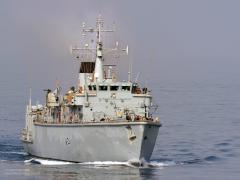
the Salisbury Island naval
base, which will see terminal
capacity increasing to around
5.2 million TEUs per year.
An analysis by Stellenbosch
University found a shortfall
between the equivalent
container stacking yard
capacity and the achievable
container throughput. The
University suggested
moving to a new
stacking system
using rubbertyred
gantry
cranes instead
of straddle
carriers and
developing
a dry port
either at the Bayhead Road site
or at the old Durban airport.
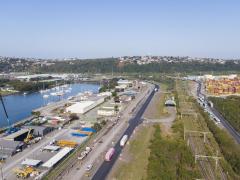
Currently an average 5000
trucks service the port per day.
Questions have been raised
around how the port authority
plans to address the congestion
outside the port when volume
capacity is doubled along with
the number of trucks.
“How is the port or the city
going to manage 5.2 million
or even the 7.05 million TEUs
they are aiming for annually in
and out of the port precinct,”
asks Mitchell Brooke, logistics
development manager at the
Citrus Growers’ Association
(CGA). “At present all of their
focus is on the waterside and it
is worrying. The infrastructure
landside is barely coping at 2.6
million TEUs. They need to
incorporate solutions for the
back end of the port into
their expansion strategy.”
Brooke believes rail has
to be a part of that strategy.
“We have to rail more reef
bound-containers – therein
lies the solution to the
landside problem.”
He says capital
from the Old
Durban airport
site should be
directed here
to substantially
increase the
rail footprint to
and from the
port. While he
maintains the site
should remain in
the public domain, he suggests
that TNPA looks at ways of
making it financially viable
and using the funds to support
landside rail developments.
“There is no logic behind a
dig out port. It
will come at an
enormous cost
and is simply
not necessary.”
Kevin
Martin of
Freightliner
however
disagrees with
Brooke – not
only on rail
as a solution
but about not
going ahead with the planned
dig out port. He suggests TNPA
should still dig out a port at the
old airport site – but for bulk
and breakbulk commodities.
“These commodities are
moving through the centre
of Durban in the middle
of the night. If we move
petrochemicals, grain, bulk and
the like to the dig out port then
those berths can be converted
and the current Durban port
would only handle containers.”
He says developing the PX
Block at Bayhead into a dry
port would create sufficient
capacity for stacking, while
simply deepening the Durban
port’s berth would allow it to
bring in the bigger vessels.
“If you handle all the exports
at the terminal and all the
imports at the PX Block, and
you run a different road to
get there than Bayhead road,
you are addressing the traffic
issue as well,” he says.
Sue Moodley of the
Harbour Carriers' Association
however agrees
with Brooke
that some form
of a rail solution
is crucial at the
Durban port.
“The dry
port concept
works very
successfully
internationally.
Develop a dry
port – be it at
PX Block or the
old airport site – and move
the containers via rail in and
out of the port,” she says. “I
don’t think we need to dig
out a whole new port when
we have a working model
available.”
INSERT & CAPTION
Develop a dry
port and move the
containers via rail in
and out of the port.
– Sue Moodley
Is rail or a dig out port the answer to Durban’s congestion headaches?
Comments | 0
© Now Media. This content is protected by copyright and may not be adapted or republished. If you would like to discuss cooperation opportunities, please contact: editor@freightnews.co.za.