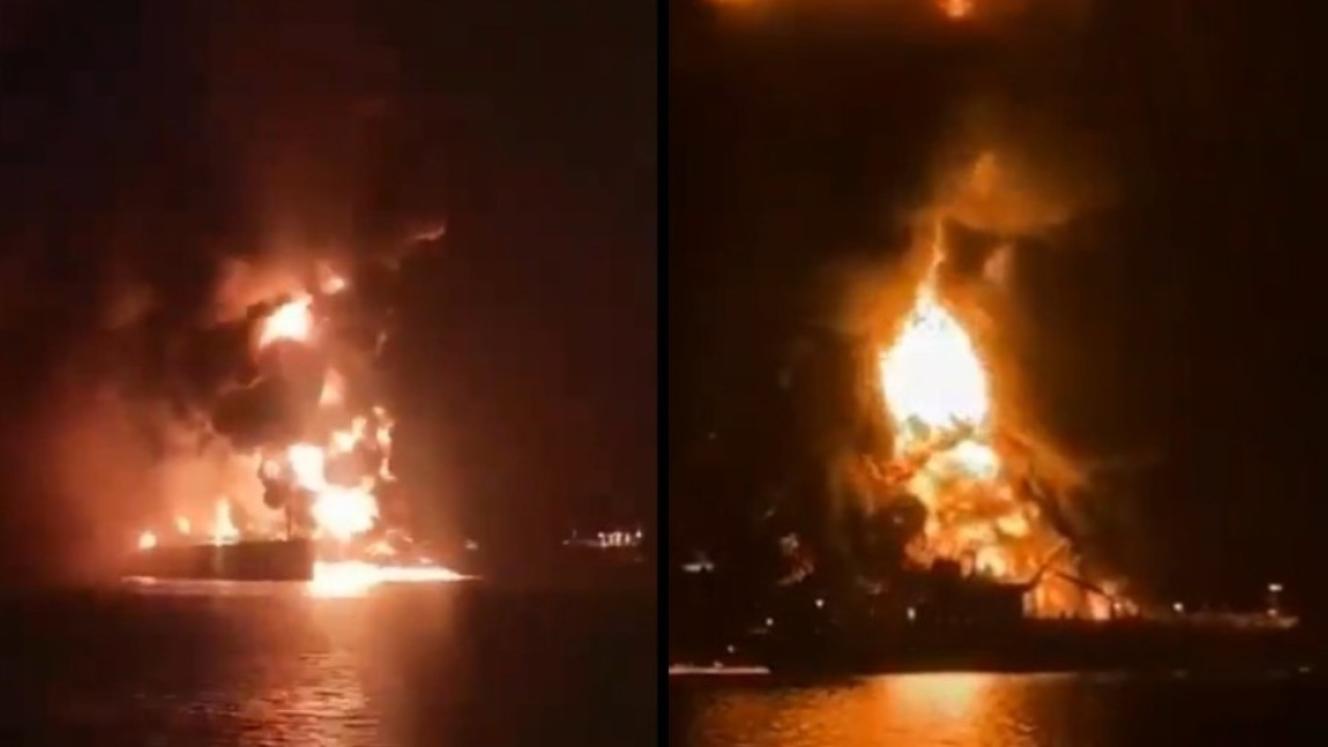
At least one crew member died and 38 seafarers were rescued in what seems to be the most vicious attack by Iran on tanker traffic off its Persian Gulf coast.
Reuters reported two foreign-flagged oil tankers, including US-owned Safesea Vishnu and a Maltese-flagged vessel, caught fire after strikes involving drones or suicide boats.
The incident occurred in Iraq's territorial waters, prompting port shutdowns and ongoing searches for any missing crew.
One victim was reportedly an Indian national.
The attacks were carried out overnight near the ports of Khor Al Zubair and Al-Fah in Basra, close to Iraq’s border with Iran.
Farhan Al-Fartousi, from Iraq's General Company for Ports, told state television the midnight attacks had resulted in one fatality and that search and rescue work was still under way at 3:50pm Arabia Standard Time.
Gulf News reported that he did not specify the crew members' nationalities or provide details on who was behind the attack, which occurred roughly 50 kilometres (30 miles) from the coast.
“However, India's embassy in Iraq said on Thursday that an Indian national had died in the attack, with 15 other Indian crew members evacuated.
“The Iraqi government's media cell told national news agency INA that ‘two tankers were subject to sabotage’.”
Daily Maverick reports that Iraqi authorities said the vessels had been attacked overnight by Iranian boats laden with explosives.
“Hours earlier, three other ships had been struck in the Gulf. Iran's Revolutionary Guards claimed responsibility for at least one of those attacks, on a Thai bulk carrier that was set ablaze,” the newspaper reports.
The Caspian Post reports that Iran’s President Masoud Pezeshkian has outlined specific conditions for ending the ongoing hostilities, including attacks on maritime vessels amid the broader Iran war.
According to Investing Live, these prerequisites for peace are recognition of Iran's "legitimate rights", payment of reparations for damages, and firm international guarantees against future aggression.
Al Jazeera reported that the framed the war had been ignited by the "Zionist regime and the US", emphasising Tehran's commitment to regional peace only under these terms, with no explicit expectations of a cessation of maritime vessel attacks.
Pezeshkian indicated that unless the US and Israel’s bombardment of Iran stopped, attacking commercial vessels in the Persian Gulf and the Strait of Hormuz would be part of Iran’s defensive strategy.
As the Strait recorded 13 days of official tanker traffic not moving through the waterway because of the conflict, Cargo Explorer reported that very large crude carrier (VLCC) rates from the Middle East to China had hit a record $423 736 per day.
Before hostilities began on February 28, VLCC rates for the same route stood at $151 000 per day.
Reuters has reported that since the war started, Iran has moved an estimated 13.7 million barrels of crude oil via its dark fleet through the Strait of Hormuz.
Sky News has reported that 15 shadow fleet vessels have transited the Strait during this period, primarily carrying Iranian oil destined for China and India, while blocking or deterring other commercial traffic.
Remote sensing detected eight dark vessels inside the Strait on March 10 alone, confirming ongoing low-visibility movements despite the effective commercial shutdown.
The Guardian reports that these operations involve AIS-off ships, including possible VLCCs near Iran's side, enabling Tehran to sustain exports of about 1.05 million barrels per day on average.
Overall, official tanker cargo through the Strait has decreased by as much as 90%, Argus Media reports.
The London maritime news source says transit counts since the start of the war show that daily averages through Hormuz have gone from 60-138 under normal conditions, to less than a vessel a day.