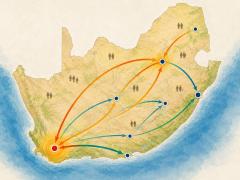
Based on the current status quo, South Africa’s freight demand is forecast to grow by 152% from 2009 to 2040, says Dr Jan Havenga, director of the Centre for Supply Chain Management at the University of Stellenbosch. “The only way the country will be able to handle this growth cost-effectively is with the development of an intermodal system,” he says. “The most efficient supply of longdistance freight transport is via intermodal solutions.” According to Havenga, South Africa will have to move beyond the “road versus rail” debate and rather focus on the big picture and realise that to bring down the high transportation costs an intermodal approach is the only solution. “Growing uncertainty around oil price fluctuations and increasing environmental consciousness arrested the global decline in rail freight transport,” he says. “Since 2004 the global rail market share has started to grow slightly, mainly due to a marked growth in intermodal traffic.” In Europe the turnaround to rail was targeted while in the USA rail also began to play a role again, concentrating on corridor transport. In South Africa, though, the reverse has been true,” says Havenga. “In South Africa the corridor problem will become pronounced. Nearly R2 trillion of cargo is shipped on corridors – nearly half of this on the N3 and N1 only, with nearly two thirds of the nation’s freight bill spent on corridors.” According to Havenga, 40-50% of this freight is rail friendly and could be transported more cost-efficiently by an effective road/rail solution. “The possibilities for savings are enormous – maybe at least R12 billion – and probably much more. The development of intermodal solutions for dense, longdistance corridors in South Africa is long overdue.”
‘Intermodal solutions could save R12bn’
Comments | 0
© Now Media. This content is protected by copyright and may not be adapted or republished. If you would like to discuss cooperation opportunities, please contact: editor@freightnews.co.za.