Transport and logistics operators have called for urgent infrastructure rehabilitation, greater financial accountability and accelerated digitisation at the Port of Richards Bay.
The industry this week highlighted deteriorating conditions, increasing truck damage, alleged health and safety shortcomings and a lack of administrative responsiveness to issues affecting port users.
The issue has escalated to national government level following an official submission by Mike Fitzmaurice, vice president for southern Africa of the African Union of Transportation and Logistics Organisations (UAOTL/AUTLO), to Transport Minister Barbara Creecy, calling for urgent intervention.
Formal industry submissions detailing the concerns had been with the Port of Richards Bay's leadership for more than six weeks without an integrated response, Fitzmaurice told Freight News.
Despite multiple follow-up emails to acting port manager Fortune Magqabi regarding submissions made on March 30 and April 20, neither the port, Transnet, nor Creecy had provided an official response, Fitzmaurice said.
Infrastructure and accountability concerns
At the core of the operational concerns is the Gate Zero staging facility – opened in December 2024 and managed by an external property group – alongside the port's internal gravel roads.
Fitzmaurice highlighted major legal and safety concerns regarding the operation.
"No evidence has been made available to us of the required due diligence and/or an Environmental Impact Study being conducted prior to the development and opening of the Gate Zero Facility," Fitzmaurice said.
"This is particularly critical given that overhead high-voltage Eskom power lines exceeding 66 KV cross directly over the truck park."
Fitzmaurice called on Creecy and Transnet to conduct an audit of the financial operations at the site.
He said transporters were required to pay an access fee of R157 per truck. Based on daily volumes of 600 to 800 trucks, between R39.5 million and R52.7m may have been collected from operators over the past 14 months. However, the site remains an unpaved, unmaintained gravel lot.
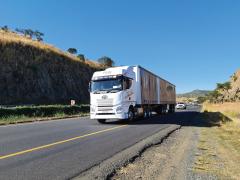
"The conditions shown above are directly responsible for mechanical and tyre damages, adding to the already high diesel and operating costs being experienced by transporters," Fitzmaurice said.
"There is absolutely no transparency or accountability for these funds. This is very concerning and an audit of these funds is urgently required."
The Road Freight Association (RFA) has strongly backed these concerns.
RFA CEO Gavin Kelly warned that infrastructure neglect was placing significant financial pressure on operators.
"The financial toll is severe and quantifiable," Kelly said.
"A fully-tyred truck-and-trailer combination carries between 18 and 22 tyres, each costing R14 500. Operating on degraded gravel and through standing water can reduce tyre life by a third or more. Across a fleet of even 10 trucks, that represents an unbudgeted liability of R2.9m or more."
The South African Freight and Logistics Association (SAFLA) has warned of a broader economic impact.
"The financial consequences of this deterioration do not remain isolated within the trucking fraternity. They cascade directly into the cost structures of the broader logistics chain," SAFLA executive officer Dave Logan and vice chair Jonathan McDonald said in a joint written response to Freight News.
The concerns extend beyond mechanical damage to alleged violations of basic human rights and the Occupational Health and Safety Act (OHSA). Drivers face long hauls and wait two to three days in queues without access to clean, functioning sanitation facilities. According to the industry, the permit staging area is filthy and unmaintained, while the Schinzel staging area has no toilets at all.
"The conditions at these staging areas are not the result of resource constraints or logistical complexity. They are the result of neglect and a fundamental failure of duty of care by those responsible for managing these facilities," Kelly said.
Calls for digitisation and rail reform
The industry is also calling for an immediate transition from manual processing systems to digital alternatives. The current manual ticketing system at the coal terminal can take up to 30 minutes per vehicle, compared with about three minutes under an automated system, according to the industry.
"The manual ticketing system at the Richards Bay Coal Terminal is a quantifiable, daily drain on corridor efficiency, for which there is no credible justification in 2026," Kelly said.
"Every truck spending 30 minutes at a gate that should take three is a truck not moving cargo and not generating the export revenue this country needs. That is not an operational detail. It is an economic emergency."
SAFLA also recommended digitisation of the system.
"The tools exist. The technology is proven. The argument that manual systems are adequate is not supported by the evidence, and the cost of inaction is being borne by operators, freight forwarders, cargo owners and ultimately the South African economy," Logan and McDonald said.
To resolve the impasse and restore corridor efficiency, the combined logistics sector is calling for:
• Immediate Gate Zero suspensions and relocation: Suspending all access fees charged to transporters until legal due diligence requirements have been met, alongside identifying a more suitable, fully compliant location for the facility.
• Full financial audits: A comprehensive disclosure and line-by-line audit from Transnet and port management regarding the funds collected through Gate Zero since December 2024.
• Urgent infrastructure rehabilitation: Immediate grading and paving of internal port staging roads, the gravel road to offloading points, and the implementation of proper OHSA-compliant sanitation facilities.
• A digitalisation roadmap: The publication of a binding digitalisation roadmap by Transnet within 30 days to introduce an integrated vehicle booking and scheduling system.
• Rail capacity recovery: Moving beyond short-term interventions to address underlying freight rail constraints.
"What is required is not another round of stakeholder meetings that yield no binding commitments. What is required is a structured, time-bound recovery plan for freight rail on the Richards Bay corridor, supported by genuine public-private partnership arrangements – not the extraction of fees from private operators to fund the management of a problem that Transnet created," Logan and McDonald said.
Transnet and the Department of Transport had not responded to Freight News’ requests for comment by the time of publication.