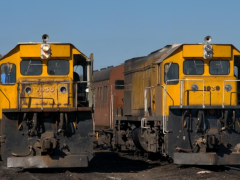
The pre-Christmas gridlock of rail-borne containers in Durban has been cleared up, allaying fears that the Transnet Freight Rail (TFR) Durban-Johannesburg shuttle service was about to pack up completely. This followed a total jam-up at the Port of Durban, with containers waiting to move up to Gauteng by rail – and dwell times of up to 14 days being reported as common. Intermodal operators and shipping lines blamed this on management and operational inefficiencies at both TFR and Transnet Port Terminals (TPT). But TFR surprised its critics, putting contingency plans into operation, according to Kerwin Naidoo of intermodal operators, Cargo Movers Kazerne Container Depot (CMKCD), and clearing up the backlog over the festive season. However, he and other rail users didn’t write off the fact that TFR was no doubt assisted by the quiet holiday period, with a big reduction in the number of ships berthing at the port’s two container piers. But the good news was that the situation improved quite considerably, Naidoo added, and things had begun to move as scheduled into the New Year. “It has improved dramatically,” said Ron Frick, MD of DAL Agency, brought the worrying problem for his line to the attention of FTW, and who feared at that stage that things might get worse. This because during the height of the problem Frick was disturbed by the fact that, although excuses were many and ranged from wind delays at the port to a train derailment, no-one had come up with any solutions to the ongoing problem. Indeed, it became so bad, he told FTW, that it had been addressed with Transnet at high levels. This was confirmed by Jan Nair, CEO of Grindrod Intermodal, who said that it had led to Transnet senior management being pushed for answers. This high-level lobbying seems to have worked, with the rail movement of containers once again up to speed. “But,” said another port user, “we’ll have to wait and see what happens when container volumes start to pick up again later this quarter – and TFR and TPT are once again put under pressure.”
Hats off to TFR for resolving rail jam-up
Comments | 0
© Now Media. This content is protected by copyright and may not be adapted or republished. If you would like to discuss cooperation opportunities, please contact: editor@freightnews.co.za.