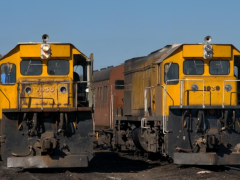
Two of the world’s Top 20 container shipping lines, Germany’s Hapag-Lloyd and Chile’s CSAV, are in talks about a potential merger. Hapag-Lloyd currently operates the world’s sixthlargest container ship fleet with a 4.2% share of the world’s fleet, according to the French-based shipping information service, Alphaliner. The CSAV fleet ranks number 20, with a 1.5% share. If the two lines combined (to form a 5.7% share), that would create the world’s fourth-largest container ship fleet after CMA CGM, which holds an 8.5% share, and before Evergreen Line with 4.7%. Information released to FTW by Hapag-Lloyd revealed that discussions were being held about what it terms “a possible business combination or any other form of association”. To date these discussions have not resulted in any binding or non-binding agreement between the parties. But Hapag assured FTW, should any relevant development occur, more information would be released to this publication. Meanwhile, in Chile, shares in CSAV surged after Die Welt newspaper reported that Latin America’s largest container shipper was negotiating a merger with its German rival. Last Thursday (just after the announcement), the shares rose as much as 27%, the biggest intraday advance since March 1, 2012, and were up 14% at close of business at the Santiago stock exchange. This is bound to be welcomed as CSAV has been in a dire financial state since 2010. The billionaire Luksic family – which holds a 46% stake – has put more than the equivalent of R10 billion into CSAV in the past two years, after the company lost a record R12.5bn in 2011. Also, CSAV’s 86% loss in the past three years is the worst performance among peers tracked by Bloomberg, as the industry struggled to recover from a slump in global shipping rates. Hapag-Lloyd also came close to collapse in 2009 but was eventually rescued in a complex deal with a consortium including Hamburg business people and the City of Hamburg. In response to a glut of new vessels, operators – such as AP Moller-Maersk, MSC and CMA CGM, the world’s top three – have formed the P3 Alliance, to lower costs and eliminate excess capacity on trade routes. Similar sentiments may be behind the possible tie-up between the German and Chilean carriers. Meantime, Hapag Lloyd has obviously identified the advantages of mergers and alliances. In March 2012, it was one of the six founder members of the G6 Alliance – now on an expansion course to extend its current competition with P3 onto the TransPacific and TransAtlantic trades. It has also been looking for a possible merger with another line for some time. Earlier this year, it and fellow German line, Hamburg Süd, ended merger talks which had been under way since December 2012. CAPTION Hapag-Lloyd set for merger? Combined the lines would create the fourth-largest fleet.
Hapag-Lloyd CSAV merger talks
Comments | 0
© Now Media. This content is protected by copyright and may not be adapted or republished. If you would like to discuss cooperation opportunities, please contact: editor@freightnews.co.za.