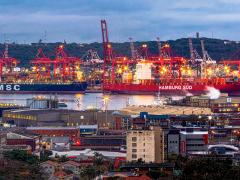
Durban port users have commended Transnet Port Terminals for setting the bar high in aiming to make Durban port one of the top five ports in the world within the next five years – but have raised concerns about the need for consistent productivity levels across port operations.
Durban transporter and former chairman of Durban Harbour Carriers’ Association, Kevin Martin, welcomed the objective but said that while the port could likely achieve this goal in terms of becoming one of the top smart ports, earlier research had shown that there was still a long way to go to grow production throughput volumes.
Martin said an analysis comparing equipment and land capacity at Durban port with top ports such as Kelang, which moved 8.8 million TEUs a year, and Shanghai, which moved 29 million TEUs, showed there was room for improvement.
Durban port’s productivity declined from a peak of 2.7 million TEUs in 2015 to 2.6 million in 2016 and to around 2.4 million in 2017. Martin said Kelang had managed to achieve higher volumes with fewer cranes than Durban for the period reviewed. Kelang has 26 ship-to-shore cranes and does 341 000 container moves per crane per annum.
Shanghai, which has 397 ship-toshore cranes, does approximately 68 000 moves, and Durban, which has 22 cranes does around 123 000. Martin added that truck turnaround time through the container terminal had improved, albeit from low levels where delays ranged from 18 to 36 hours two years ago.
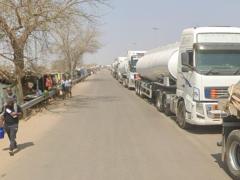
“There is progress and we are going in the right direction. We get some days where maybe only four or five trucks will be longer than six hours in the terminal – and sometimes there are days where every vehicle on average takes six hours,” Martin said. He said on bad days delays were still sometimes between ten to 12 hours.
However, Martin said the port’s announcement that it planned to make the truck appointment system mandatory by next year with fines for transporters who missed their scheduled arrival slots would only hamper productivity. He said it made more sense to work with booked and unbooked slots so that if transporters were delayed and could not arrive on time the missed slots would not sit idle but could be used productively to serve other transporters.
Durban Harbour Carriers’ Association chairperson Sue Moodley said port stakeholders were working closely with Transnet Port Terminals to address the challenges around productivity and truck turnaround times. She said the port’s aspiration to be among the top five ports was a commendable goal but implementation was a challenge.
“I think they have a long way to go. They want to go in the right direction but they need to set themselves against a yardstick of where they need to go,” Moodley said. “Their truck turnaround time is meant to be 90 minutes but they haven’t met it for quite a few months although they meet it from time to time.
They still have equipment issues and spatial planning issues – and with the deep berthing project coming through, they don’t seem to have contingencies that are solid and workable, something I relayed to them at a recent meeting,” Moodley said.
Transnet had a “phenomenal” management team but implementation of its production strategy was not being achieved, partly because the workforce was highly unionised and productivity volumes were not adequately measured, she added.
“They don’t look at productivity output per crane and per driver. If they were looking at it like that then they wouldn’t have the problems they have.” Moodley said to improve productivity it would be helpful for Transnet to privatise the running of certain parts of the port by putting some port operations out to tender.
“If the private sector gets involved you will see competitiveness and economic development in the port but it doesn’t seem to be part of the government’s agenda,’ Moodley said.
INSERT
It would be helpful for Transnet to privatise the running of certain parts of the port by putting some port operations out to tender. – Sue Moodley
INSERT AND CAPTION
We get some days where maybe only four or five trucks will be longer than six hours in the terminal. – Kevin Martin