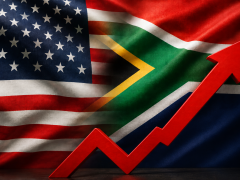
All is not lost despite the
recent spate of credit rating
downgrades – but South
Africa needs to act now.
That’s
the view
of Wesgro
economist
Janine
Botha who
told a business
delegation in
Cape Town
recently that
against a
background
of poor GDP
growth,
political
instability
and policy
uncertainty
the downgrades had come as
no surprise.
“We can turn this
around. It is imperative
that we avoid any further
downgrades which would be
catastrophic.”
But with all the top rating
agencies having given South
Africa a negative outlook,
more downgrades seem to be
inevitable, in her view.
“The outlook is an
indication of where the
rating agency is going next.
Positive indicates a rating
upgrade in the
intermediate
term, stable
remaining
where one is
and negative
pointing most
likely to a
downgrade,”
she said. “That
is the problem
for South
Africa as we
have several
negative
outlooks at
present and
we simply
cannot afford any more
downgrades.”
She said it was imperative
that business stayed clear of
the term junk when referring
to South Africa as it was
unfair and not warranted.
“Rather refer to the status
as being speculative grade
or non investment. All of
our endeavours should be
aimed at getting us back into
investment grade.”
But, she said,
developments were
disturbing and not pointing
in the right direction.
The recent release of
the Mining Charter has
raised more concern as it
is commonly accepted that
as it stands it will deter
investment and carries huge
consequences for an already
fragile sector.
“Recent comments by
the Public Protector on
the Reserve Bank are also
worrying as this has been
one of the few entities in
the country that has been
seen as extremely positive.
Muddying thoughts around
the SARB is not going to
help our current situation.
We remain on negative
watch,” she said.
While the Mining Charter
and the Public Protector’s
comments are closely aligned
to the “radical economic
transformation” narrative of the
new finance minister, Malusi
Gigaba, and President Jacob
Zuma, it is
not a stance
that the rest
of the world is
embracing.
It’s rather
seen as a
populist policy
at the expense of
economic growth.
Botha said strong leadership
in a politically certain
environment where relative
policy stability was guaranteed
could turn the entire situation
around.
“It won’t be easy but we
can change this and avoid
South Africa being further
downgraded. An improvement
in governance that is
supportive of public finances
and the business climate
can ensure an upgrade,” she
said. “Trust also needs to
be re-established between
government, business and
labour.”
It’s imperative that
business stays clear
of the term junk
when referring to
South Africa as it
is unfair and not
warranted.
– Janine Botha