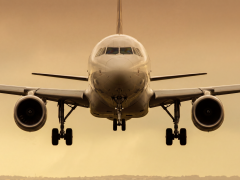
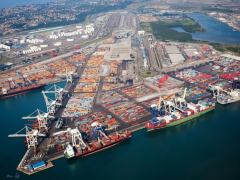
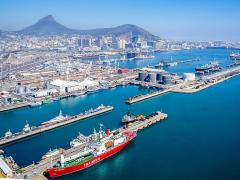
Engen strike raises further concern, writes Leonard Neill FUEL SUPPLIES are being railed to Johannesburg International Airport to combat the serious shortage facing airlines following the recent Natref refinery fire at Sasolburg which has plunged the airline industry into a state of chaos. As each of 13 tankers arrive in Durban by sea, the jet fuel and diesel aboard is being hurriedly offloaded and directed to Gauteng. It should ease the situation, says Minister of Minerals and Energy Phumzile Mlambo-Ngcuka, who has held urgent talks with refinery officials and airport authorities throughout the past week. The shortfall will, however, continue for the next three weeks, she says, until Engen's Durban refinery, which has been closed for maintenance, reopens on July 4 and is fully back on stream. During this time the maintenance workers have been on strike. Insiders in the shipping and airline industry have warned that there is currently no assurance that Engen will be up and running as planned on July 4. "We will have to wait and see what effects the three-week strike at the plant has had on reaching the deadline date in time," says Cockett Marine's Ian Grayston, whose company monitors the supplies of marine diesel and fuel available at South Africa's harbours. While attention during the early days of the fuel crisis has been given to airlines and those in the transport and agricultural sector depending on diesel, Grayston has pointed out that marine diesel, which is a different commodity, is in short supply and dependent on the reopening of the Engen refinery. "Remember they had the strike during the maintenance work period when the refinery had already been closed down," he said. "We must wait and see if they will be ready to start up again on July 4. If they aren't, the position may well be disastrous." Meanwhile airlines are making contingency plans to deal with the situation, the majority of major international operators topping up at mid-African destinations such as Nairobi to ensure they arrive in Johannesburg with sufficient fuel. Each has been rationed to 70% of their normal intake at JIA, and by taking on board additional fuel on the inbound flight, can safely have full tanks with their 70% allowance on the northbound flight. Virgin Atlantic has arranged to shuttle on to Durban, at significant cost, and refuel there, while both Lufthansa and British Airways, which have Cape Town depots, are utilising these by flying their aircraft to the coast for refuelling. Others have decided either to refuel elsewhere in Africa or to use empty space in southbound cargo holds to carry additional fuel. Domestic services are using coastal depots where adequate fuel is available for the same purpose.
Fuel shortage hits air and sea
Comments | 0
© Now Media. This content is protected by copyright and may not be adapted or republished. If you would like to discuss cooperation opportunities, please contact: editor@freightnews.co.za.