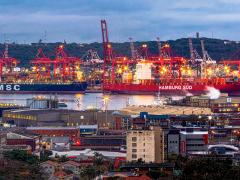
Congestion will continue to result in lost export orders THE SA forwarding community Ð whose clients are the bulk of this country’s exporters and importers Ð are up in arms about the congestion surcharge of US$75 per container to be imposed in the Port of Durban by the US/SA Shipping Conference on November 15. This dissatisfaction has been expressed in a letter from the SA Association of Freight Forwarders (SAAFF) to four cabinet members - Jeff Radebe, Minister of Public Enterprises; Dullah Omar, Minister of Transport; Trevor Manuel, Minister of Finance; and Alec Erwin, Minister of Trade and Industry Ð and to Mafika Mkwanazi, c.e. of Transnet and Siyabonga Gama, c.e. of the National Ports Authority (NPA). The letter reads: “As you are, of course, aware, the backlog situation in Durban harbour - particularly at the container terminal - has now reached a point where industrial, manufacturing, export and other business activities are being very seriously affected.” This, according to Dave Watts, executive of the Kwa Zulu Natal Association of Freight Forwarders (KNAFF), has been highlighted by this substantial congestion surcharge - effective November 15. “And we have no doubt that all other liner conferences will shortly follow suit,” he added. The view expressed by SAAFF is that not only will these surcharges negatively affect year-on-year inflation rates, but also export prices to international customers will increase. “Perhaps more important is the negative effect currently being experienced with delays in the logistics chain. “Delays which will have a deleterious effect on the future growth of manufacturing and export industries, and on investment decisions being made by both local and foreign investors. “The nation’s economic future relies not only on our already-proven ability to compete in world markets, but also to deliver to those markets efficiently, reliably and on-time,” said Watts. But, he added, the consistent congestion difficulties experienced in Durban over the last few years will continue to result in lost export orders, redirected manufacturing investments and job losses. Meantime, the association supports the state’s plans for concessioning of port services, according to Watts. “But clearly this process will take time, and action to provide infrastructure and experienced management support is required immediately, as a major impact on the economy is imminent. “It is our belief,” he said, “that interference on any level with port activity should be an offence in terms of the relevant Acts. “That industrial action - such as lock-outs, go-slows and strikes - require at the very least cooling-off periods, and third party arbitration, before any kind of industrial action can be undertaken.” The SAAFF letter urges the authorities to consider its suggested plan of action and similar comments being tabled by other role players in the logistics industry. “We have no doubt that the difficulties currently being faced at our ports are at the top of these ministers’ departmental agendas,” said Watts. “But we have respectfully urged them to wait no longer before putting our suggestions into practice. “The congestion is a nightmare, and all of us in Durban are going to lose out as shippers and importers find other ports where there are no similar delays.”
Forwarders lobby government support over congestion surcharge
Comments | 0
© Now Media. This content is protected by copyright and may not be adapted or republished. If you would like to discuss cooperation opportunities, please contact: editor@freightnews.co.za.