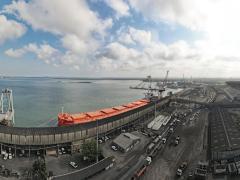
Swimming against the global tide when it comes to scrapping ships and slow steaming, South Africa’s trades appear to be sailing relatively smoothly. Taking out ships, scrapping them, slowing them down or idling them for shorter or longer periods, has been a trend in the world’s major trades as lines struggle to balance supply and demand. Maersk Line’s North Asia CEO, Tim Smith, was quoted as saying these tactics had managed the overcapacity on the Asia- Europe trade fairly well. But, he told Bloomberg recently: “That is the game we need to play again in 2013.” According to The AlixPartners Container Shipping Study, global container shipping divisions face declining profitability as they move into 2013. In 2012, the study added, relief came later in the first half, thanks to rate increases on both the Transpacific (Asia to US) and the Asia-Europe trades. But those early gains started to erode, with carriers again beginning to rationalise capacity in anticipation of a more challenging time ahead. Investigating the options available to shipping lines to combat overcapacity, Research and Markets (R&M) warned of the threat the sector faces in 2013 with the influx of newbuilds and the impact this will have on the market if demand has not picked up sufficiently. But both they and AlixPartners pointed to the comparative health of the north-south trades being a partial solution for the smaller vessels being stooddown on the major trades as the megas take their place. According to R&M, the strategy of diversifying into emerging trade routes (ETRs) – including SA – will offer a safe haven to lines as growth on them continues to tick up. This, it noted, as ETRs are not as affected by the decline in rates as over-saturated developed routes. “However,” their report added, “while offering shortterm aid to the beleaguered container sector, they will not be the industry’s saviour in the medium term, as volumes shipped on these routes are not great enough to carry the sector.” AlixPartners expressed similar thoughts. “The trades seeing the greatest growth are the so-called “emerging-to-emerging” routes involving the northto- south trades,” they said. “However, these trades carry only one-fourth the volume of the main trades.” But they did hint that efficient operation on these developing trades was better suited to the smaller, more flexible vessels – the type of vessels from which carriers have been shifting away on the main trades. “These n-s trades have been fed mainly by vessels cascading from the traditional Transpacific and Asia-Europe trades when new, larger vessels displace existing tonnage,” they added. This has become evident in the Port of Durban, as vessels with a container capacity of even up to 9 000 TEUs have become a commonplace sight alongside the container terminal berths. And the word from local shipping lines is that, although the SA trades took a battering in 2008/9 and 2011/12 and services were cut or pulled off, the present scenario is one of gradual recovery. Ron Frick, MD of DAL Agency, told FTW that the SA Europe Container service of which DAL is a member had actually increased its fleet size from seven to eight vessels. Admittedly, that was due to delays at the SA ports at the southern end of the loop, and a need for an extra vessel to maintain their named-day schedule, not a matter of a boom in demand. “But,” he added, “although the northbound trade contracted marginally, there was 2% to 3% growth on the southbound leg.” Looking at the Asia- SA trade, Iain McIntosh, regional sales manager of Mitsui OSK Line (MOL), told FTW that the carriers had been “voiding sailings”. “MOL, Safari, MSC, Evergreen – everyone really – has been doing this pre and post the Chinese New Year, as there has not been enough cargo. “But it’s only temporary. Structurally, on the SA trade, we don’t see any service or fleet cuts.” CAPTION The 11 660-TEU MSC Sola, which called at Durban last July, was the largest container ship ever to call at an SA port …a growing trend.
Emerging trade routes offer safe haven to struggling lines
Comments | 0
© Now Media. This content is protected by copyright and may not be adapted or republished. If you would like to discuss cooperation opportunities, please contact: editor@freightnews.co.za.