The outlook for growth in airfreight transport remains slow due to a range of global economic factors but strong economic growth in several African countries will help to buoy the demand for intra-Africa freight services. This is the view of PricewaterhouseCoopers economist Christie Viljoen who said the five subSaharan African countries that were expected to achieve the highest average growth rates in the 2019-2021 period were Rwanda and Ethiopia in East Africa and Cote d`Ivoire, Ghana and Senegal in West Africa. “The two East African countries are forecast to grow by more than 8% per annum while the three in West Africa are projected to grow by close to 7%. This will be notably higher than an average of around 4% per annum for the sub-Saharan Africa region.” Viljoen said trade friction between the United States and China, Brexit, and a slow-down in Germany’s economic growth were expected to contribute to
slow global economic growth that would impact demand for airfreight in 2019. According to the International Monetary Fund’s (IMF) January 2018 World Economic Outlook Update report, global growth was projected to be at 3.5% in 2019 and 3.6% in 2020, a few percentage points below its 3.7% projection in October due to the negative effects of tariff increases in the US and China. “These are all key markets for African soft commodities such as fruit and flowers which are transported by air. Intra-Africa freight volumes will not be affected
as negatively due to continued strong growth on the continent,” Viljoen said. According to the International Air Transport Association’s most recent statistics released on January 15, North America, Middle East and Latin America were the only regions to report growth in airfreight volumes while demand in Asia Pacific, Europe and Africa contracted. According to Iata, African carriers saw freight demand decrease by 7.8% in November 2018, compared to the same month in 2017. Capacity also shrank 7.4% year-on-year.
“Demand conditions on all key markets to and from Africa remain weak. Seasonally adjusted international freight volumes are 7% lower than their peak in mid-2017; nonetheless they are still 28% higher than their most recent trough in late-2015,” Iata said. Viljoen added that Africa’s ability to expand its airfreight volumes was limited by the continent’s longstanding challenges to develop its infrastructure. “Improved airport and
associated infrastructure would reduce costs associated with air transport and open up more markets for African commodities,” he said.
CAPTION:
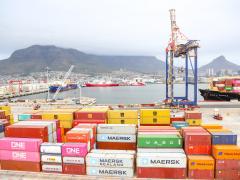
Strong economic growth in several African countries will help to buoy the demand for intra-Africa freight services. – Christie Viljoen