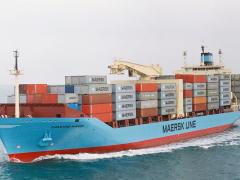
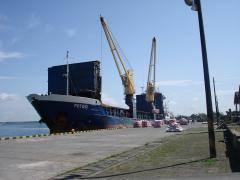
For the Barnhoorn family, flowers have been a way of life for the past three generations. Today the directors of Hadeco, Floris and his sons Charles and Stuart Barnhoorn, are continuing a family tradition that started when their grandfather, Floor, in 1946 relocated his young family from Holland to South Africa. With his friend Harry de Leeuw, Floor was determined to make a success of the business, working long hours in difficult conditions to establish what is today Hadeco. Both left school at the age of 14 to make a living selling bulbs for growers. Having survived the Second World War, the two Hollanders had a simple dream – to grow and sell the world’s finest flower bulbs. And they did. From his office Charles Barnhoorn looks out over the farm where his grandfather and De Leeuw spent hours tending their first bulbs, growing gladioli as cut flowers to make some cash. “Today we are one of the largest flower bulb growers in the world, but we have never lost sight of the obsession for excellence of my grandfather and the original partners – reliability of supply and genuine concern for customer satisfaction,” he says. “These are values that are an integral part of Hadeco’s culture.” Offering more than 50 different kinds of bulbs to markets in more than 55 countries, Hadeco is one of the top perishable product exporters not only in Gauteng, but the country as a whole. “Our breeding programme was first established in 1950 and it becomes more extensive every year. We continue to add to our service offering all the time as it not only keeps us ahead of our competition, but it is part of the vision that my grandfather had when he started the company – to keep introducing new hybrids to the market. Being able to grow a new flower is something extraordinary,” says Barnhoorn. “Sometimes it takes four or five years before it is ready for the market, but if you grow it well and you do it all correctly, you have something very special and rewarding in your hands.” Farming across seven farms in Gauteng, Mpumalanga and North West, knowledge is handed over from generation to generation with techniques at play that no school can teach. The Little Falls farm remains the hub of the organisation as it houses the laboratory where some 25 000 hybrid plants can be found – all in various stages of growth and experimentation. Here the bulbs and cut flowers are all packaged and distributed locally and internationally. Hadeco exports some 60 seafreight containers of bulbs and 150 tonnes of cut flowers annually. “We use airfreight for our cut flowers as it is a highly perishable product that must get to its final destination as quickly as possible. Our bulbs are containerised and shipped out of the Port of Durban. We truck them to Durban as rail is not an option for us as Transnet doesn’t run reefers from Johannesburg.” Having in the past used only airfreight, the decision to move to sea transport was based on cost, says Barnhoorn. “The cost has increased so much that we found no clients were willing to take early airfreight delivery of their bulbs any more at that rate. They preferred to wait for the seafreight to arrive.” With its main markets in Japan and Europe, the company has in the past two years seen a major decrease in exports to the United States. “The global economic meltdown no doubt played a major role in that,” he says. “We increased our sales into Europe to make up the difference as we found that despite the recession flower markets in this part of the world have held their own and retained their price and volumes.” The biggest competition comes from Brazil where the government is giving more and more support to exporters, with shipping costs being reduced extensively while the currency has also depreciated more than the rand. South African bulb growers therefore have to remain one step ahead at all times, according to Barnhoorn. “And the way you do that is by having the best varieties of bulbs on offer while keeping in very close contact with the customer base across the world.” Being based in Gauteng logistics costs can and do impact at times – especially when planning is thrown out due to the announcement of late stack dates at the port. “Our logistics costs are about 10% of the delivery price of the product, but in many cases it is still cheaper for our European clients to buy from us rather than from Holland for instance.” This is because South Africa has the right climate at the right time of year to allow for blooming bulbs over Christmas in Europe. “The Dutch can also accomplish it, but they need greenhouses to do it and it is more expensive.” The company prefers to use smaller service providers to the big boys of the logistics industry. “It is about quality and a serviceorientated approach. We have found that smaller companies allow for more personal attention – something that is extremely important when one has a perishable product,” he says. And the smaller service providers have also respected the perishability of the product and the understanding that Gauteng, the hub of their operations, is far from the market and therefore no delays can be tolerated.
Dutch courage plants the seeds of successful bulb exporter
Comments | 0
© Now Media. This content is protected by copyright and may not be adapted or republished. If you would like to discuss cooperation opportunities, please contact: editor@freightnews.co.za.