A project cargo undertaking of rare specifications, unusual both in scale and scope, has seen the transport of two smelting furnaces and their tilting frames from Witbank to the Highveld and on to Durban before Höegh Autoliners shipped them to Surubaya.
The furnaces had been decommissioned by Transalloys, a global silico-manganese supplier in Mpumalanga at the time they were sourced and bought by Gulf Manganese, an Australian mining consortium working in Kupang on the Indonesian island of West Timor.
The first hinterland leg of the asset relocation involved moving the furnaces and their tilting frames to industrial sites in Springs and Nigel for refurbishment by Xram Technologies. The project presented a complex set of challenges for logistics company Themba Dry Cargo.
“It was one of the most unique projects we have worked on since the inception of our company about 12 years ago,” general manager, Eurika du Plessis, told FTW from their West Rand offices.
Her colleague, marketing executive Wanda Blignault, added that just moving the equipment to the respective refurbishment sites in Ekurhuleni “was a major exercise”. Once Xram had completed its part of the project some 18 months later, Themba Dry Cargo used the same company it had contracted to bring the furnaces to Gauteng, Jacobs Transport, to get it down to Durban. “All of these assets were out-of-gauge items and required careful cooperation with the relevant authorities to move it down to port,” said Blignault.
She added that when she had been told it could take five days she had listened in disbelief, “but it literally did take that much time to move it down the N3.”
Finally, with Durban’s harbour in their sights, there was a height discrepancy with one of the trailers “and we couldn’t pass underneath a bridge. “Authorities had to close a section of the highway at three in the morning so we could reverse the entire operation onto another section of road.” Part of the challenge, said Blignault, was getting the right shipping company. “We contacted a couple but because of the out-of-gauge proportions of the assets we were turned away by all but one – Höegh Autoliners.
“They were literally the only one that could help.” William Hepplewhite, Höegh’s head in Africa, explained that it had taken some careful manoeuvring to fit the items into the main deck of the Osaka as everything was “over-width by at least a metre or more.”
The two tilting frames weighed 18 000 tons a piece and each extended two metres over the shipping platforms onto which they were lashed. The furnaces weighed even more, 21 100 tons each, and were 1.35m over-width.
“But it’s the type of cargo our vessels are designed to handle,” Hepplewhite said. He added that it was also the type of cargo Höegh was aiming for because “we’ve looked at the breakbulk cargo market and have identified a growing need for big-ticket cargo projects”. Interestingly, the Osaka, with about 45 400 sqm of space for some 5 400 cars, a ramp width and weight of 8m and 100t respectively, and a maximum cargo height of 5.1m, is not one of the biggest vessels in Höegh’s fleet of some 40 roll-on roll-off vessels (ro-ros).
According to Hepplewhite, Höegh currently has six of the world’s biggest ro-ros in its fleet, vessels that can take up to 8 500 car equivalent units, has a ramp strength of 375t, and a maximum cargo height of 6.5m.
“It’s a totally new type of vessel, geared towards enabling the kind of capacity, and more, of the kind of items we shipped for Themba Dry Cargo.”
Blignault has meanwhile said that Gulf Manganese has indicated it will require another six furnaces and tilting frames for the same smelting works outside Kupang over the next five years.
The two furnaces were shipped directly to the Indonesian port of Surubaya. Ancillary parts, comprising nine 40-foot containers of smelter components and structural steel as well as hydraulic power plants and two large transformer units, were separately shipped on board the Maersk Sheerness to Singapore, from where the cargo was transhipped to its final location.
INSERT
We’ve looked at the breakbulk cargo market and have identified a growing need for big-ticket cargo projects – William Hepplewhite.
CAPTION
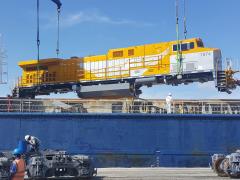
Harbour marshalls manoeuvre into position one of the manganese smelting furnaces that Höegh shipped to Indonesia.