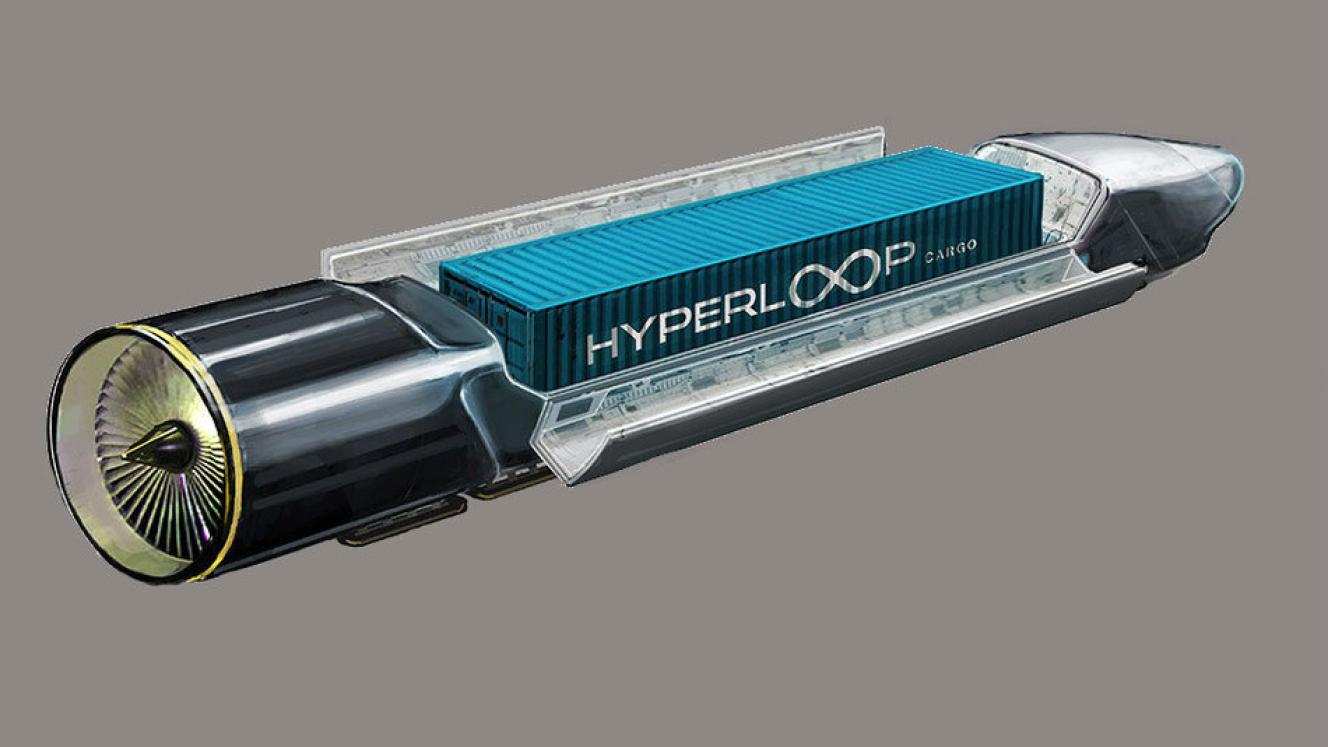
Hyperloop cargo transport could join the freight industry’s investigation of how to switch to new transport technology, and some test run data could be available this year.
This is defined by Wikipedia as: “A conceptual high-speed transportation system originally put forward by entrepreneur Elon Musk, incorporating reduced-pressure tubes in which pressurised capsules ride on an air cushion driven by linear induction motors and air compressors.”
Musk’s concept was made public in a preliminary design document in August 2013, which included a notional route running from the Los Angeles region to the San Francisco Bay Area – with several proposed branches including Sacramento, Anaheim, San Diego, and Las Vegas.
Preliminary analysis indicated that such a main route might obtain an expected journey time of 35 minutes, meaning that it would traverse the 560 kilometres at an average speed of around 970 km/hour, with a top speed of 1 200 km/h.
The preliminary cost estimate for the LA–SF route was the equivalent of R116.25 billion for a somewhat larger-diameter version.
European routes have also been put forward. In January 2016, a Paris to Amsterdam notional route was proposed by Delft Hyperloop, and a Warsaw University of Technology team is evaluating potential routes from Cracow to Gdansk across Poland proposed by Hyper Poland.
Designs for test tracks and capsules are currently being developed, with construction of a full-scale prototype 8km track scheduled to start this year. In addition, a subscale pod design competition on a very short 2km test track is under way, with test runs expected later in the year.