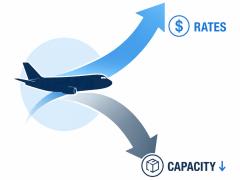
Global airfreight rates are still trending up on the back of shipments moving into the traditional year-end peak season, the latest figures published by TAC Index in partnership with the Baltic Exchange show.
The headline Baltic Air Freight Index rose by 6% during November, signalling a clear month-on-month increase.
Rates out of major Asian hubs have also strengthened.
Recent updates from Air Cargo News report that the Hong Kong outbound index recorded a notable month-on-month (m-o-m) rise, with spot rates from Hong Kong to North America and Europe increasing by more than 8%.
Data releases from the Baltic Exchange similarly point to widening gains across key Asia-origin corridors, particularly Hong Kong and Shanghai, where demand has strengthened more sharply than analysts had anticipated earlier in the quarter.
These increases support industry indicators of “unexpected momentum” in volumes and pricing during the late-2025 peak season.
However, index analysts caution that describing the trend as applying “across major trade lanes” is interpretive rather than strictly data-driven.
While Asia-origin lanes have seen broad rises, performance elsewhere remains more uneven.
This includes some North American origins.
Market commentary from rate providers and freight analysts also highlights growing uncertainty beyond December, supply chain news site The Loadstar reports.
Volatile macroeconomic conditions, shifting e-commerce traffic and evolving trade patterns have made forecasting into early 2026 unusually difficult.
For that reason, statements that “visibility beyond December is shrinking rapidly” are regarded as fair reflections of current industry sentiment, even if they do not represent measurable or quantifiable indicators in the way an index movement does.
Recent summaries from the TAC Index also point to rates on several major Asia-origin corridors continuing to climb on an m-o-m basis, though the exact breadth of these increases depends on the specific indices and publication dates referenced.
As long as the latest published figures show rising indices on the principal Asia-US and Asia-Europe routes, the assertion that rates are climbing on “most major Asia-origin corridors” remains directionally accurate, albeit still an interpretation rather than a verbatim statement from the data.
Taken together, the latest data and commentary support the conclusion that peak-season pricing strength is real, but that broader generalisations should be treated as analytical framing rather than strict fact.