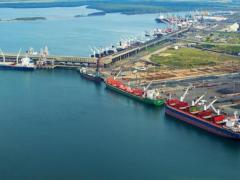
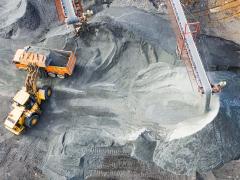
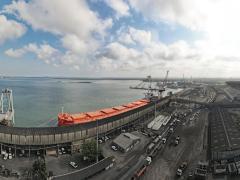
WHILE MOST cargo owners – particularly high volume shippers – are courted by shipping lines for their business, that’s not always the case, particularly if your cargo is classified by the International Maritime Organisation as hazardous. It’s a strange irony that AEL, whose explosives play such a critical role in the raw material supply of steel and ferrochrome used in the manufacture of ships, is one of the companies that tends to get the cold shoulder from a number of carriers. “We supply the explosives for iron ore mines – and while ships will gladly carry the iron ore, they won’t carry the product that helps to produce the ore from which they make a lot of money,” says AEL commercial services manager Ron McConnell. And this from a company that is “obsessively” strict on safety. “We’ve never had a shipment that has caused an explosion by road, rail, air or sea – and with a 110-year-old reputation at stake, it’s an area where there are never any compromises,” he said. But apart from its link to shipping through its involvement in the mining of raw material, the company’s positive contribution to the transport industry often goes unnoticed, says McConnell. Recent projects in which AEL has played a key role include the Port of Cape Town, Coega as well as the Gautrain. AEL is the supplier of the huge quantities of explosives used to blast hard rock from the container terminal basin in Cape Town. The blasting has been necessary to deepen berths 602, 603 and 604 to 15.5 metres. It’s been on the go since February, but because it’s underwater blasting, it’s silent and therefore of no nuisance value to surrounding business. According to AEL product manager John Truter, a preblast ‘advisory or scare charge’ ensures that marine life is unaffected by the action. The port was last deepened in 1977 also with the assistance of AEL. The company has also been an important player in the supply of explosives for the construction of the deepwater port at Coega while the Gautrain has provided a different set of challenges for the explosives giant. “During the past 20 years advances in commercial explosives technology have focused mainly on the safety of the product during manufacture, transport, storage and use. There has been extensive research and development worldwide and the overall implication of all this work is that the modern commercial explosives are less hazardous to transport than any other flammable liquid or chemical,” says McConnell, who believes reluctance on the part of many shipping lines to carry their product is largely related to ignorance. “Lines carry a lot more dangerous cargo than ours could ever be.”
Carriers shun explosive cargo out of ignorance’
Comments | 0
© Now Media. This content is protected by copyright and may not be adapted or republished. If you would like to discuss cooperation opportunities, please contact: editor@freightnews.co.za.