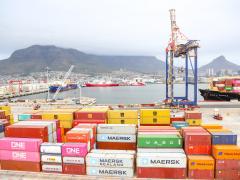
Joy Orlek THE JOHN Marsh Maritime Collection is gaining international status as a sought-after reference source, with orders flowing in from France, UK, Australia, Canada and the United States for negatives of the unique photographs. Housed in the Maritime Museum on Cape Town’s Waterfront, the collection tracks the history from cradle to grave of almost every ship that called at the Port of Cape Town in the 1930s and 1940s. It was the passionate life’s work of FTW founder John H Marsh who took the photographs over a period of 68 years, and catalogued them with his inimitable attention to detail, recording the human drama, the details of where each vessel was built, the colours in which it sailed, and where it eventually came to rest. Human drama at sea was his primary interest and it was a factual account of the cast-aways from the wreck of the Dunedin Star in the desert in the far north of Namibia in 1942 that became the best seller ‘Skeleton Coast’. The book is still in print today. When John Marsh died in 1996 the collection was donated by the estate to the museum where a full-time researcher, Peter du Toit, is based. Like John Marsh, who from the age of 14 as a pupil at Seapoint High School cycled daily to the elbow of the Victoria basin and photographed every ship in the harbour, a pursuit he continued as editor of the Cape Argus for 20 years, Du Toit shares a passion for the sea. Since his early days at Wynberg Boys High School in Cape Town, Du Toit was also a regular visitor to the port, walking the quays, boarding passenger ships, and taking photographs with his Brownie camera. Born into a banking family, this is the career path he followed until his retirement in 2000 in Cape Town when he revisited his shipping involvements of the past. Du Toit says that the website has proved to be a most important medium of communication for the collection as people all over the world track the ships in which their relatives might have sailed. Several thousand of the negatives in the collection of 19 000 are of vessels that were sunk during World War 2. Not only does the collection offer a print of the ship, but also shows where it was sunk, and if it was sunk by a U-Boat, the captain of the ship that sunk it. It’s information that doesn’t exist anywhere else and is a key element of Cape Town’s cultural heritage. Sadly, however, it appears that financial considerations are encroaching on the Mother City’s maritime soul as rumours of a gym taking over the Museum’s prime position on the Waterfront prevail. Clearly a health club could generate more money, but maritime historians would surely argue that in this instance there are more important issues at hand. Access the website at www.maritimemuseum.ac.za
Cape’s maritime history to be muscled out?
Comments | 0
© Now Media. This content is protected by copyright and may not be adapted or republished. If you would like to discuss cooperation opportunities, please contact: editor@freightnews.co.za.