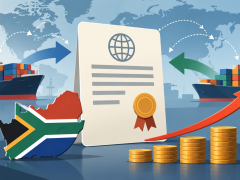
India’s year of chairing BRICS has been marked by a focus on increasing trade between the member countries. This could create new opportunities for increasing business with South Africa’s top BRICS trade partners – China and India, which are two of the original BRIC states – Brazil, Russia, India and China. China accounts for between 63 and 70% of SA’s total BRICS+ trade and India 26-27%. Brazil is around 4%. Speaking at the September 11 BRICS Business Forum in New Delhi, India, Indian Prime Minister Narendra Modi called on BRICS countries to cut trade barriers and expand business opportunities, saying India is building economic bridges amid rising global protectionism. “Today, as trade barriers are increasing around the world, India is building economic bridges. Since 2014, we have entered into free trade agreements with nearly 40 countries around the world. Our approach within BRICS is also the same: reduce barriers and expand opportunities for businesses.” Speaking at the session, President Cyril Ramaphosa called on BRICS governments and business communities to use the grouping as a platform to deepen investment and trade, reshape existing economic patterns and transform the economies of countries across the Global South. “We cannot accept a future where Africa supplies the minerals on which the next generation of industries depends, while value addition and manufacturing take place elsewhere. “If we are to change where value is created, we must also change where investment is directed. “We must direct investment towards manufacturing and beneficiation, industrial technologies, energy systems, infrastructure and logistics. “As governments and business communities, let us make BRICS a platform through which investment and trade reshape existing economic patterns and thereby transform the destinies of our countries and peoples,” he said. Modi urged the BRICS Business Council to identify the top 10 trade barriers among member countries and propose ways to remove them. One of the main barriers was identified by the meeting of BRICS finance ministers and central bank governors, which issued a statement calling on member governments to “strengthen our collective efforts to enhance global economic resilience, sustain investment and growth and preserve an open and inclusive global economic environment”. It said progress had been made in customs cooperation between BRICS countries, with the establishment of a “strong institutional framework for collaboration in areas such as authorised economic operators (AEO), digitalisation and intellectualisation, customs enforcement and capacity building”. Practical initiatives include the first BRICS joint customs enforcement operation, encouraging the BRICS customs centres of excellence to undertake targeted training and technical cooperation programmes responsive to members’ needs and aimed at strengthening institutional and operational capabilities, and the promotion of structured cooperation through the BRICS customs working groups. For now, a BRICS currency to replace the US dollar is not on the table, according to Shri Sudhakar Dalela, Secretary (Economic Relations) in the Indian Ministry of External Affairs (ER). In answer to a question at a media briefing, he said “there is no proposal in the BRICS for BRICS currency as of now. “The focus is on how we can do more intra-BRICS trade and engage with the global business community more actively and reduce transaction costs”. ER
BRICS focus on business spin-offs for regional trade
Comments | 0
© Now Media. This content is protected by copyright and may not be adapted or republished. If you would like to discuss cooperation opportunities, please contact: editor@freightnews.co.za.