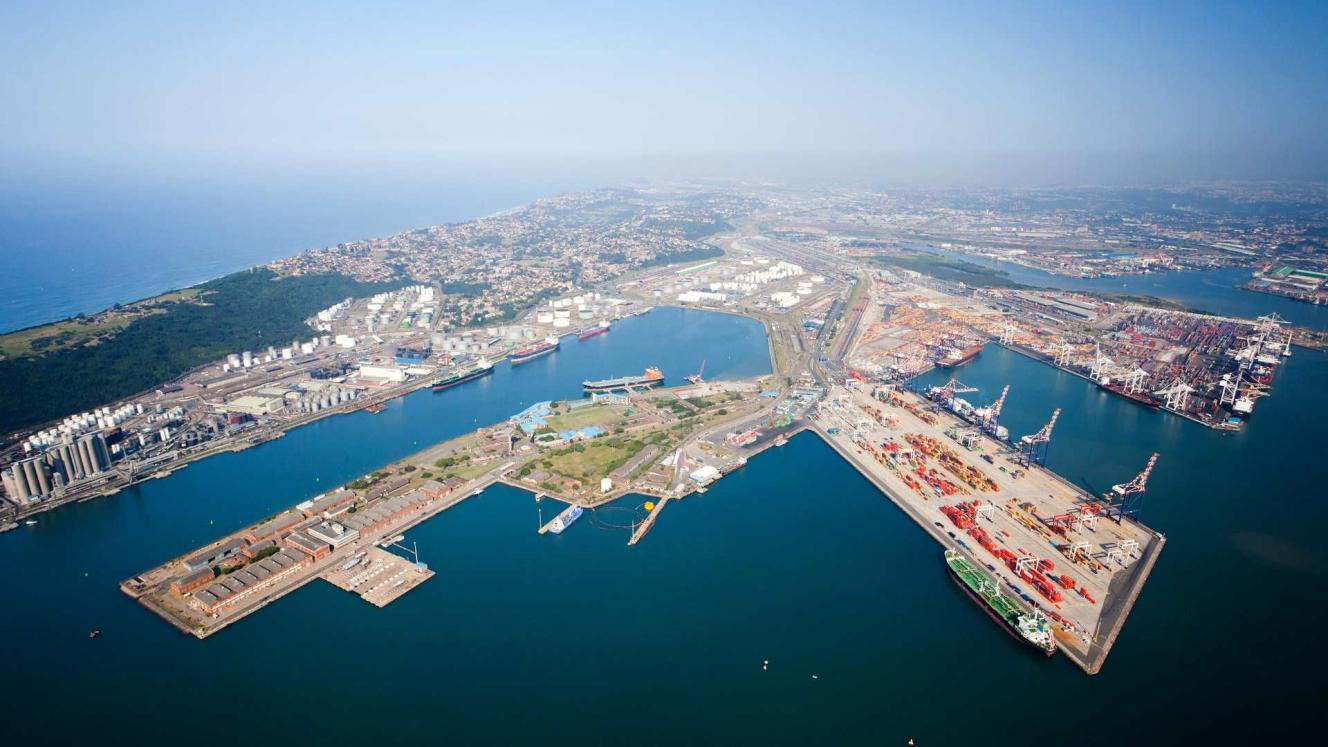
Landing 48-metre pontoons weighing over 100 tons each on to a remote beach in northern Mozambique was part of the day’s work for the team that shipped over 100000 cubic metres of freight weighing 15 million kilograms for the Moma Sands mine in northern Mozambique. Röhlig Grindrod was responsible for the total logistics function. It took “a good few months to plan the logistics,” says Rayno van Niekerk, managing director of Röhlig- Grindrod Mozambique. He is based in Maputo, Mozambique, where the company offers specialised services in exports, imports, in-transit shipments, transportation of project cargo, vehicles, raw materials, break bulk and containerised cargo, as well as customs clearing. In the middle of 2010 Röhlig- Grindrod presented EP+C with a programme based on feasibility and road studies, consolidation and packing plans, multimodal transportation management, exact stowage planning, statistical calculations, risk management, handling, choice of appropriate loading equipment, personal loading and unloading supervision, documentation and customs clearance, and web-based tracking and tracing options were included in the highly complex project plan, he says. The project started in January 2011. Moma is the world’s largest titanium deposit. It is located 160 kilometres from the city of Nampula, and is owned and operated by Kenmare Resources. Kenmare doubled the capacity of the mine, with construction work starting in December 2010. Total production of heavy mineral concentrate (HMC) for 2012 was 772300 tons, according to Kenmare chairman Justin Loasby. In his introduction to the 2012 Kenmare annual report, he says the mine produced 574000 tons of ilmenite and 46900 tons of zircon. Some 680000 tons of finished product was shipped in 2012, generating revenues of US$234.6 million – 40% up from the US$167.5 million in 2011. Vessels are loaded through a dedicated jetty, which handled 39 vessels in the 2012 financial year. Kenmare supplements the jetty with a barge system. Röhlig- Grindrod also had to make use of barges for the discharge of the project cargo. An exposed beach operating system (EBOS) system was used to land 15 pontoons measuring 48 metres in length, 5.4m in width, 3.8m in height and weighing 107 tons each. They were offloaded on to a geared barge. A careful watch had to be kept on the weather as the barges could not operate in swells greater than 2.5 metres. “We obtained daily reports from ocean satellite imaging systems to monitor the weather. During the duration of the project we had to cope with a few tropical storms that developed into cyclones – one of which was Irina,” says Liz Gaynor, national projects manager Mozambique for Röhlig- Grindrod. “As a result we experienced some delays in discharging from the vessels and barges”. Once the pontoons had been landed on the beach they were loaded on seven-axle trailers with a capacity of 150 tons and carried some six kilometres from the beach to site. The logistics processes became even more challenging during the November to April wet season, when 80% of the annual rainfall falls in the region. “In March 2013 when flooding prohibited us from getting trucks to the site, we had to hire a selfpropelled barge to ship the cargo by sea from Nampula to Moma Sands,” says Gaynor. But, the challenge started at the point of manufacture in Richards Bay some 700 nautical miles away. Traffic lights had to be moved and overhead electrical cables removed in order to transport a 7.5-metre high by 10-metre diameter surge bin just five kilometres from where it was built to the port. The remainder of the cargo was discharged in Nacala and transported by road to Moma Sands. In total, 100000 tons of cargo was delivered from suppliers in Australia, the USA and South Africa to the Moma mine – not only in the right order but also according to a defined schedule, says Gaynor, who was based in Johannesburg for the operation. Röhlig-Grindrod had dedicated staff stationed at Moma Sands and the client’s premises in Centurion, as well as Johannesburg and Durban, for the duration of the project. The project was completed by May 2013, when the last consignment of freight arrived at the destination. Kenmare has since commissioned the new plant. INSERT & CAPTION 1 It was a highly complex plan. – Rayno van Niekerk INSERT & CAPTION 2 We experienced some delays in discharging from the vessels and barges. – Elizabeth Gaynor INSERT 3 100 000 Total tons of cargo delivered INSERT 4 US$284.8 million in revenue generated in 2012
Year-long logistics planning pays off for Mozambican mine
Comments | 0
© Now Media. This content is protected by copyright and may not be adapted or republished. If you would like to discuss cooperation opportunities, please contact: editor@freightnews.co.za.