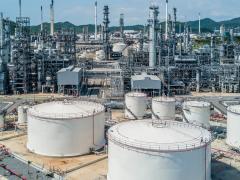
Less than seven years ago – in July 2008 when oil hit a high of US$145 a barrel – the pundits confidently predicted that oil would hit US$200 a barrel. Two reasons were given for the increase – growth of the Chinese economy and “peak oil” – the realisation that global oil reserves had hit a tipping point, and the world had simply consumed more oil and gas than was left in the ground. By December 23 in the same year, the price had plummeted to US$30.28 at the start of the 2007-2010 financial crisis. Hauliers and shipping companies no longer had to contend with runaway fuel prices, but with shrinking loads and demand instead. This put pressure on costs, which ensures that fuel consumption continued to drop as energy efficiency throughout the transport value chain improved. More efficient power plants also help meet the demand for continued reduction of emissions. Shipping companies and hauliers who continue to update their fleets are in a strong position ahead of the next run in the oil price – whenever that happens. What is indisputable is that there will be a tipping point, assuming that it has not already been reached. Hydrocarbons were created millions of years ago, and the earth is not producing any more. Hopes that biofuels or electric power will fill the gap have not yet materialised. Biofuels in particular face a “peak” of their own – seven billion people to feed. The question, therefore, is when will the oil price start rising again? Clearly the pundits do not have the best record when it comes to crystal ball gazing. Interestingly, US$200 a barrel is back on the table. This time the blame is being put on uneconomically low prices. Oil companies have stopped investing, and wells are running dry. Claudio Descalzi, chief executive of Italy’s oil giant ENI (which has interests in Mozambican offshore gas), is quoted as warning that the roller-coaster move in prices is destructive for the oil industry and is leading to investment cuts that may lead to shortages. “What we need is stability - a central bank for oil. Prices could jump to US$150 or even US$200 over the next four or five years,” he told journalists in Davos earlier this year. The main reason given for the apparent oversupply at present is fracking in the United States and production from oil sands in Canada. The USA and Canada are responsible for about 120% of the increase in world oil production since 2005. A US Department of Energy advisory council stated late in March this year that “shale won’t last beyond the next decade.” The announcement came as part of a study submitted to the department by the National Petroleum Council at request of Energy Secretary, Ernest Moniz. The report advised that the US should begin an immediate push to exploit oil in the Arctic waters off Alaska, or be at risk of a renewed increased reliance on imported oil in the future due to the decline in domestic oil production. Environmentalists have reacted with alarm, and will undoubtedly slow the process down. Oil companies have another big challenge – the cost of extracting oil from increasingly difficult locations such as offshore fields lying hundreds of metres under water and rock – the Kifaru-1 well off northern Mozambique, for example, was drilled to around 4 050 metres. Onshore deposits are also hidden under thousands of metres of hard rock. Adding to the costs is the logistics of moving drilling equipment and then rigs to the isolated locations, and then the transport of the oil or gas that is being pumped out. Writing for Oilprice.com, correspondent Ron Patterson sums it up nicely: “All the good cheap stuff has already been sucked up. We are now left with dregs at the bottom of the barrel. All today’s new oil is harder to find, depletes a whole lot faster, and costs many times as much to produce”. Hauliers, shipping companies, power utilities using gas and rail operators running diesel traction units will have to be prepared for the next spike – which history shows us can happen in a matter of months. INSERT & CAPTION The roller-coaster move in prices is destructive for the oil industry and is leading to investment cuts that may lead to shortages. – Claudio Descalzi INSERT $200 The level to which oil prices could jump over the next four to five years.
When will the oil price start rising again
Comments | 0
© Now Media. This content is protected by copyright and may not be adapted or republished. If you would like to discuss cooperation opportunities, please contact: editor@freightnews.co.za.