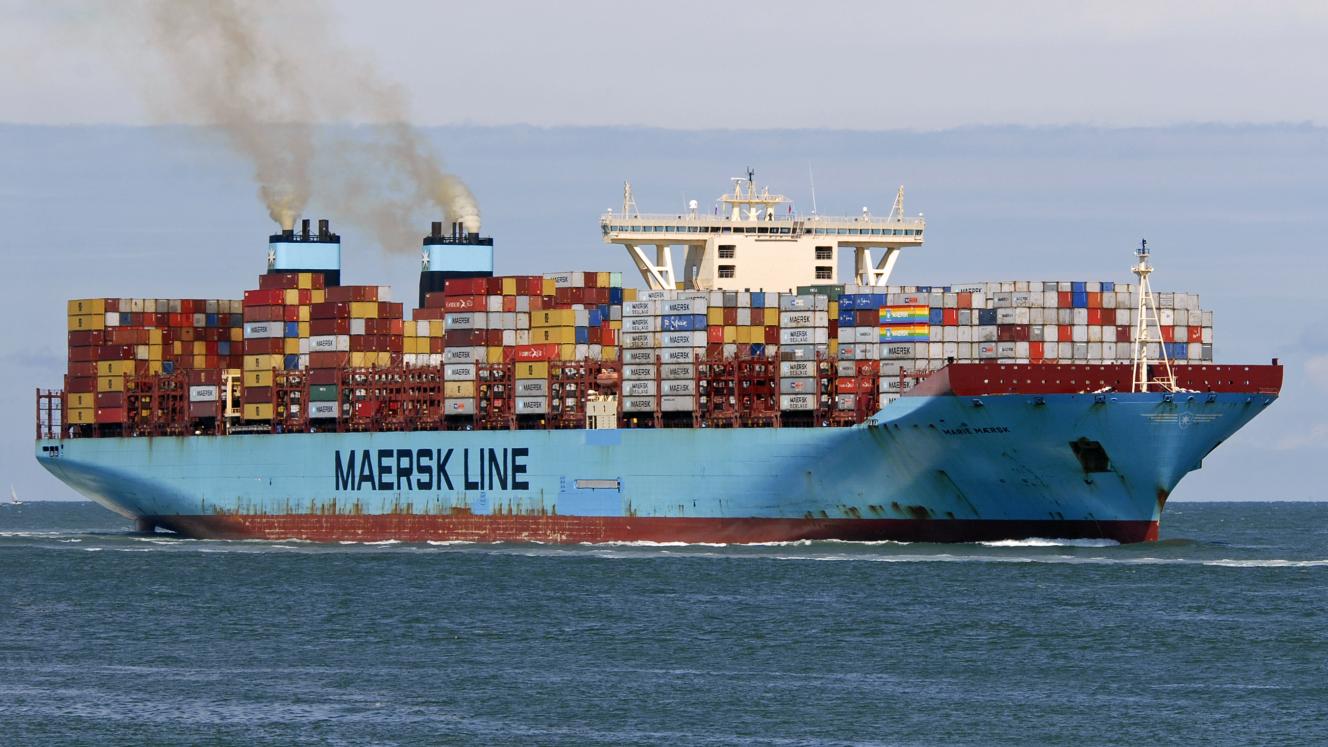
From a backwater trade – full of chronic port congestion, small, necessarily self-geared ships and limited investment in port development – the West Africa sea trade has evolved rapidly into one of the world’s fastest growing. The French shipping consultant, Alphaliner, has revealed exciting indicators of just what has been happening on this trade in the past five years. In 2009 the vessels trading from the Far East to West Africa averaged 2 300 TEU capacity. But by 2014 this had increased to an average of 3 800 TEUs. And, in 2011, Maersk was one of the bigger-ship leaders, with the introduction of the first of its 22 purposebuilt, four-crane, ‘WAFmax' class vessels of 4 496 TEU capacity – the largest geared containerships ever built. And Alphaliner pointed out at the end of last year that the size of the largest containerships on that FE-WAF route had increased by 87% since 2009. Also, from a minor throughput of 170 000 TEUs in 2009, the total capacity of containerships sailing the FE-WAF trade rocketed up almost 250% to 590 000 TEUs last year. A percentage that makes the trade one of the fastestgrowing sectors in the container shipping market. And that self-geared necessity is almost no more. New infrastructure projects (many of them by private sector port and terminal operators) have f looded into the WAF ports. And this, over the last couple of years, has overcome that chronic congestion for which they were infamous. So today at least 10 WAF ports are capable of handling gearless ships above 4 000 TEU capacity. Said Alphaliner: “Gearless ships currently account for 50% of all container vessels deployed on the trade, compared to only 8% in 2011.” This trend to bigger, gearless ships has thrown a lifeline to the panamax vessels that have cascaded out of the larger trades. Many of them were f loating around with nowhere to go. But the WAF trades have led to the resurrection of many such ships. Alphaliner figures revealed that 26 gearless panamax units in the 4 000-4 600 TEU range are now deployed on the FE-WAF trade – a big jump up from the four units in 2013. And 25 gearless overpanamax ships of 4 600-6 600 TEU capacity have also appeared over the past 12 months or so. And this bigger-ship trend is set to continue. Recent infrastructure development projects are making room for even more of those overpanamax vessels. Pointe Noire in the Congo, Luanda in Angola and Lome in Togo are all now capable of handling ships of more than 6 000 TEU capacity. And the new Lome Container Terminal (LCT) is the star of the show. Developed by MSC’s subsidiary, Terminal Investment Limited (TIL) and China Merchant Holdings (CMH), this greenfield terminal is capable of taking ships up to 14 000 TEU capacity, with a draught of 15.5 metres. There are also two other greenfield developments which will add to the new regional transhipment capabilities on the West African coastline. Major investments are planned by two shipping companies. CMA CGM is to develop the new port at Lekki in Nigeria, while the Maersk group’s terminal operators, APM Terminals (APMT), are aiming at developing the port of Badagry, also in Nigeria. These new port developments, according to Alphaliner, could lead to the introduction of containerships of up to 9 000 TEUs by 2017. Changed days indeed since 2010, when geared ships in the 1 500-3 000 TEU range were the backbone of the West Africa trade – and still more is to come. CAPTION Pointe Noire is now capable of handling ships of more than 6000 TEU capacity.
West Africa the world's fastest-growing trade
Comments | 0
© Now Media. This content is protected by copyright and may not be adapted or republished. If you would like to discuss cooperation opportunities, please contact: editor@freightnews.co.za.