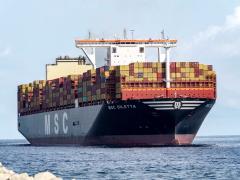
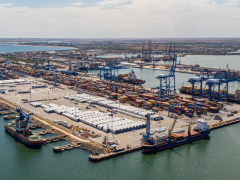
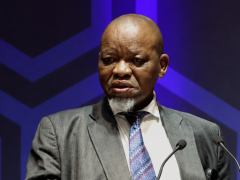
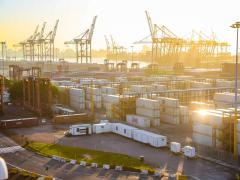
Moving a transformer weighing a few hundred tons is difficult enough, but taking it underground through a narrow tunnel is another story altogether. Yet in the heart of the Little Drakensberg mountain range just outside Ladysmith, Eskom’s logistical team has not only done this once, but twice and is gearing up to do it two more times before the end of the year. “Planning the logistics for this scheme started some seven years ago when engineers started the design of the power scheme,” says Dennis Child, who heads up Eskom’s Multi Axles Logistics Services Department. Child and his team have been responsible for delivering transformers to the Ingula Power Scheme currently under construction near Ladysmith. The pumped storage scheme that consists of an upper and a lower dam, each capable of holding approximately 22 million cubic metres of water, connected through underground waterways, will be powered by four 333-MW transformers weighing in at around 253 tons each. Defying the imagination however is the fact that the transformers had to be delivered more than a kilometre into the underground site and about 300m deep from the top of the mountain. “The tunnels had to be designed taking the specs of the truck and trailer transporting the transformer into the facility into account,” explains Child. A refreshing approach in an industry where logistics often has to play catch up while finding out-of-the-box solutions to getting cargo to final destinations. With a length of 124m and a gross combination mass of 660 tons, the transformers were driven down a tunnel 1.2 km in length with gradients of 10 degrees before being unloaded 300m below ground level. “It is not easy moving transformers,” says Child who along with his team moves an average of 100 of these a year for Eskom across the country. “It takes an average of 18 months to build a transformer and if it is damaged it has to be returned to the factory. That means an entire project comes to a halt. It would have massive cost implications.” Moving it below ground in a confined tunnel thus called for an experienced team with nerves of steel. According to Child the successful movement of this abnormal cargo was completely dependent on planning. “That goes for the movement of any transformer. It is an expensive piece of cargo that is exceptionally delicate. We plan months and sometimes years in advance. In this case the logistics was taken into account in the design stage already, but in terms of the transportation we also started planning about a year before the transformer arrived in Richards Bay.” Child compiles a daily report which is circulated across the team and to all stakeholders. “We are all on the same page and we all know what is going on,” he says. “The report is updated every day and is very clear about what is happening, when it is happening and how it is happening.” The four transformers for Ingula arrived in Richards Bay in October last year. “It is a slow process delivering the transformers as we are very restricted as to when we can travel,” says Child. “They are also delivered to a schedule determined by the construction of the power scheme. There are several things that have to be in place for cargo of this nature before it can move. That includes having the right permits and ensuring we have traffic officers who can escort the cargo.” Abnormal cargo is also embargoed from moving over weekends, at night, during school and public holidays and at peak traffic times. There is also no travelling allowed in misty conditions or when it rains. At the same time Eskom is by law obliged to let communities know prior to arrival in towns of their movements. This means advertising in local newspapers and on radio. “The vessel with the transformers arrived in Richards Bay on October 29 last year. At the time it was raining heavily so we were not able to travel. Also traffic officers were not immediately available to escort the convoy through Empangeni and so we finally left for Ingula on November 4.” Travelling at an average of 20km per hour, the convoy - which included four trucks pulling from the front and one from behind - arrived on site on December 4 with the easy part of the journey over. “It was the last 1.2km through a muddy and watery tunnel grading downwards that put the team to the test,” he says. “It was experienced by most of us as claustrophobic and a real mind shift was needed to the final point of delivery.” After a final risk assessment Child changed the combination and with one tractor pulling from the front and one pushing from behind the downward leg of the journey started. “There was a gradient drop of one to ten – so for every 10 metres we travelled the gradient lowered by a metre. It all went well until near the very end where we realised that the weight and the balance of the transformer on the trailer had shifted towards the front and that the momentum was challenging the truck combination to gain speed.” To stop the combination from running away Child decided to hook more tractors to the back to assist with the braking, and the mission was completed. “We gained some valuable knowledge and the second transformer was delivered earlier this year with no hitch. The next two should be at Ingula by the end of July.” For Child this was all in a day’s work. “It is about planning and planning and then some more planning. You can never cut corners and you have to be on top of your game all the time.” INSERT & CAPTION With a length of 124m and a gross combination mass of 660 tons, the transformers were driven down a tunnel 1.2 km in length with gradients of 10 degrees before being unloaded 300m below ground level. – Dennis Child
Tunnel vision
Comments | 0
© Now Media. This content is protected by copyright and may not be adapted or republished. If you would like to discuss cooperation opportunities, please contact: editor@freightnews.co.za.