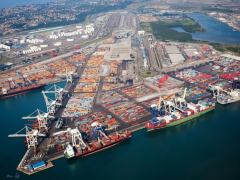
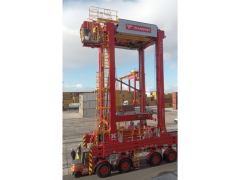
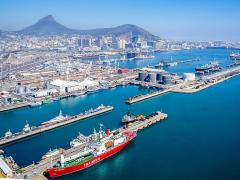
A class action against Transnet Port Terminals (TPT) suing for truck standing time at the Port of Durban (an amount described by one transport expert as “a big lot of Mandelas”) may be the only way to bring the TPT to its senses. “And the only way to get them to recognise that they have a problem,” said Carl Webb, MD of Project Logistics Management and representative of both the Road Freight Association (RFA) and the SA Association of Freight Forwarders (Saaff) on transport matters. “Let’s talk out the whole morbid story in court.” This followed another monumental jam-up of trucks on Bayhead Road (the only access to the port’s two container terminals) last week – as TPT caused congestion to get out of hand. “A weekly occurrence,” said Webb, “with traffic backed up on Bayhead Road a part of the city landscape.” And it now seems that the transport industry has eventually had enough of enough. The wires were abuzz just after the jam-up with a high traffic volume in e-mails amongst those involved in the freight industry. And one that triggered the buzz went out to hundreds of addressees in and associated with the industry (“Every man and his grandmother,” as Webb put it) complaining bitterly about Pier 1 congestion. “Poor planning and management” was its headline. Aven Naidu of Avemel Logistics, specialists in abnormal project cargo, was up in arms. One of his trucks had been stuck at Pier 1 for more than 24 hours in traffic congestion – and he couldn’t get in to load an abnormal from the vessel Ever Reward, or get out. The reasoning? TPT had five export stacks running simultaneously. This resulted in only trucks arriving with exports being serviced – as they were offloading and loading imports simultaneously. This left trucks only loading imports to stand naked and unserviced on the quay. “Further to that,” said Naidu, “the TPT staff had no idea of how to remedy the problem.” “It is just not good enough to tell us that Pier 1 is congested and expect us as a logistics community to tolerate the poor planning. “If this is the case can we now go back to the shipping lines and our clients and advise them that Transnet does not wish to load our imports any longer unless we have exports to bring in at the same time? Can we advise them that they should start engaging the services of private berthing institutions as it is clear that Transnet cannot handle their vessels efficiently?” Naidu was supported by Webb on another issue this raised. “It is inhumane and against the law to allow an employee to be on duty for more than 18 hours – and our man has been on for 28 hours and counting,” Naidu told TPT. “Please provide us with a plan of action as to how this problem is to be remedied.” Webb pointed out that truckers hauling from Johannesburg had to allow for up to two days to clear the port. “From a driver health/ sleep point of view, truckers should be able to do this in a day,” he added. “They can’t sleep in the cab while they’re waiting, because they’ll lose their place in the queue. “And, with a lot of Aids, drivers are just not as strong as they could be, and all this time taken loading/offloading just exhausts them.” Suggestions on a strategy that would wake up the port operators came from a whole host of port users – and included a blockade; a boycott; and a congestion levy. “But there was a lot of correspondence on the issue of class action by the transport industry,” said Webb, “and I feel that would be the best way of taking our frustrations forward – and looking for a solution through the courts. “This may elicit a response from TPT. Nothing else has to date.” INSERT & CAPTION Let’s talk out the whole morbid story in court. – Carl Webb
Truckers threaten class action over congestion
Comments | 0
© Now Media. This content is protected by copyright and may not be adapted or republished. If you would like to discuss cooperation opportunities, please contact: editor@freightnews.co.za.