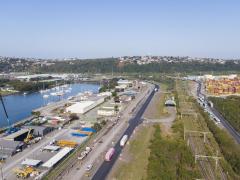
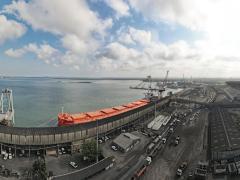
The Durban container trucking industry has suggested that Transnet Port Terminals (TPT) has forgotten its original primary objective of being a facilitator of SA import and export trade, and moved over to transhipment cargoes as its priority. There is no argument that there is some business logic behind this, according to Kevin Martin, MD of Freightliner Transport and chairman of the Durban Harbour Carriers’ Association (DHCA) – a division of the SA Association of Freight Forwarders (Saaff). “It’s about half of the business at the Durban container terminal (DCT),” he told FTW, “and is a very big part of their revenue stream. “But, although they may not have noticed it, they have changed their main objective into second place and now only favour the shipping lines’ demand for transhipment space.” Paul Rayner, MD of DTB Cartage, agreed with this sentiment. “Transhipments are taking up valuable ground slots, currently running at about 45% of the space,” he said. “And they’re not just slower moving than the import and export containers, they also take up more comparative handling equipment time. “They need three moves. The first from the ship to the stack; second from the holding stack to the appropriate export stack for the vessel; then a third from there to the ship. “And if, in the interim, they’re stacked with an import or export container in front or on top of them when they need to be shifted, that would mean still another move.” What it all means, Martin added, is that transhipments are being time-subsidised, with trucks moving import and exports boxes having to stand up to an average of three hours a day (or up to 6-8 hours on a bad day) waiting to be loaded or unloaded. “Although it would cost TPT extra time and money, if they want to make the terminal more fluid in import and export moves, they shouldn’t be mixed with transhipments. That means the only answer is for transhipments to go into their own stacking area.” Martin suggested that the most logical short-term solution would be to limit the transhipment levels, and – given time to accumulate the necessary equipment and personnel – then develop what he termed “a backstaging area”. And one space near the DCT for this would be the now unused Spoornet PX site. “This,” Martin added, “could be a private/public endeavour between Transnet and the shipping lines.” If there was any doubt left in the reader’s mind as to what TPT was favouring, Rayner concluded: “Just look at the storage charges for transhipments against imports”. This, in the tariff book, reads: Transhipments: • Day 1 to 7 – Free • Day 8 to 10 – R20.00 per TEU • Day 11 to 14 – R41.00 per TEU • Day 15 onwards – R82.00 PER TEU Imports: • Day 1 to 3 – Free • Day 4 – R632.00 per TEU • Day 5 – R1030.00 per TEU • Day 6 onwards – R1676.00 per TEU “This,” said Rayner, “means that a 20-foot (6-metre) transhipment container that dwells in DCT for say 10 days will incur storage of a total of R60.00 as opposed to R10 0042.00 for the same import box. Double the numbers for a 40-ft (12- m) box. Makes you think doesn’t it?”
TPT accused of favouring transhipment cargo
Comments | 0
© Now Media. This content is protected by copyright and may not be adapted or republished. If you would like to discuss cooperation opportunities, please contact: editor@freightnews.co.za.