Transnet National Ports
Authority has revealed plans
to develop a drone use policy
that includes guidelines and
standard operating procedures.
“Once it has the necessary
approval and support, the
drones will be deployed in the
port,” a TNPA spokesperson
told FTW.
This follows a three-month
trial in the port of Durban
at the end of last year, which
included the use of a drone to
deliver a package to a vessel,
to monitor traffic congestion
on the roads leading to and
from the port, and to provide
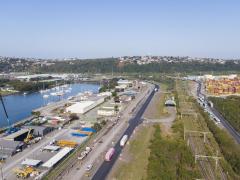
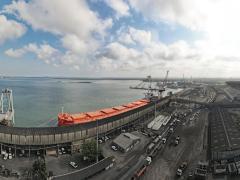
a bird’s eye view of the port
infrastructure and operations.
Ristha Joga, information,
management and services
manager at the Port of Durban,
said that the aerial and
underwater drones, as well as
track and trace technology, had
been piloted successfully at the
port.
“This proof of concept
exercise showed that drones
can be used in a number of
ways, including inspecting
infrastructure and the
condition of the sea bed, which
can be done safely without
interrupting port operations.
The drone technology can also
assist in collecting information
on port traffic,” she said.
Joga pointed out that the
new technology would be
used to complement existing
resources. “This would result in
a more empowered and enabled
workforce that could improve
the customer experience by
providing a more informed
service,” she said.
The Port of Durban remains
the pilot site for any drone
deployment and, if successful,
this could be rolled out to other
ports, according to the TNPA
spokesperson.
Drones have been identified
as one of the potential game
changers for the logistics
industry, said consulting
company PwC’s transport
and logistics leader for Africa,
Andrew Shaw.
“It’s not what the drones can
do, but rather how they can be
deployed to increase efficiencies
in the supply chain,” he said.
Managing director: strategy
for PwC in Germany, Stefan
Stroh, agreed, pointing out that
drones had been successfully
used in surveillance and
tracking in Europe.
CAPTION
The port of Durban is considering using devices similar to the Port of Rotterdam’s Waste
Shark for cleaning pollution on the water surface of the harbour.
TNPA gears up to deploy drones in the ports
Comments | 0
© Now Media. This content is protected by copyright and may not be adapted or republished. If you would like to discuss cooperation opportunities, please contact: editor@freightnews.co.za.