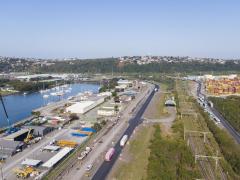
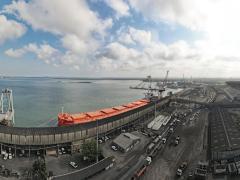
With a landslide victory at the polls, president-again Jacob Zuma has enough political muscle to push through his promise of a more businessfriendly regime – while effectively being able to counter the unions and other left-wing opposition to his declared plan. His voice and those of others in his cabinet have also rejected nationalisation of industries and vowed to restore investor confidence with stable policies. These words have been said, but what will they mean in practice? Mike Walwyn, director of Seaboard Maritime Services and chairman of the Port Liaison Forum (PLF) of the Cape Chamber of Commerce, said: “In the run-up, the ANC was talking about fostering a business-friendly environment. And, if they wish to arrest the decline in support for the party, I would think they’ll need to make good on that. “But, on the other hand, the strong showing of the EFF will tend to push them in the direction of satisfying the demands of the poor and the trade unions, so it’s not going to be easy. “And we shouldn’t ignore the possibility that, with the support of the EFF, it would be possible for them to achieve the 2/3 majority necessary to push through any constitutional amendments they may have in mind.” Andrew Pike, partner in maritime legal specialists Velden Pike Nichols, and former board member of the SA Ports Regulator, also had the EFF in mind. “Their strong showing,” he said, “gives a message to the ANC that government will have to move faster and more effectively in the creation of jobs.” He also expected more intensified efforts to bring about true transformation in the maritime sector. “This, in turn,” he said, “should (theoretically) put more wealth into the hands of the previously disenfranchised. However, in practice, that is generally not what happens.” Andrew Robinson, maritime lawyer, director of Norton Rose Fulbright SA, and former chairman of the Maritime Law Association (MLA), also hopes that the ANC’s promises will have a positive growth effect on the maritime industry. “Hopefully,” he told FTW, “the new post- May 2014 administration will assist the existing agents, chandlers, stevedores, road hauliers, ship repairers, marine insurers and brokers and the like to grow their enterprises and the number of people that they can permanently employ.” Robinson added that the new regime should also “concentrate on creating a space” which will allow for new maritime entities to enter the shipping market. “It’s hardly likely to appeal to the EFF, but there it is!” Sue Wood, operations director of Cargocare Freight Services, had a touch of cynicism in her response. “On the positive side,” she said, “I think the trend is moving in the right direction as far as future business relationships with government are concerned. “But I doubt that this small move will be sufficient to generate greater partnering of business with government. “If anything, we are more likely to see stronger pushback from industry in its fight for growth and a less harmonious relationship than even that which currently exists.” Rob Garbett, MD of Professional Aviation Services and chairman of the Business Aviation Association (Busa) of Southern Africa, saw Zuma’s “business-friendly” promises failing, unless the ANC completely restructured its current stance. “My view is that, if the ANC government continues with the bureaucratic restraints and constrictions that are suffered by small to medium businesses, this section of the economy will continue to lag. And the major victim of this policy is labour itself. I am also most concerned about the expansion, and militancy, of labour unions in the economy.” INSERT & CAPTION 1 The new regime should also “concentrate on creating a space” which will allow for new maritime entities to enter the shipping market. – Andrew Robinson INSERT & CAPTION 2 The trend is moving in the right direction as far as future business relationships with government are concerned. – Sue Wood
'Time for Zuma to make good on his promises'
Comments | 0
© Now Media. This content is protected by copyright and may not be adapted or republished. If you would like to discuss cooperation opportunities, please contact: editor@freightnews.co.za.